TSUGIMON
Japanese Snowflake Crest: The Meaning of Yukiwa and Sekka Designs
Explore the Japanese snowflake crest, from the soft yukiwa ring to detailed sekka crystals, what snow symbolized, and why it spread in the Edo period.
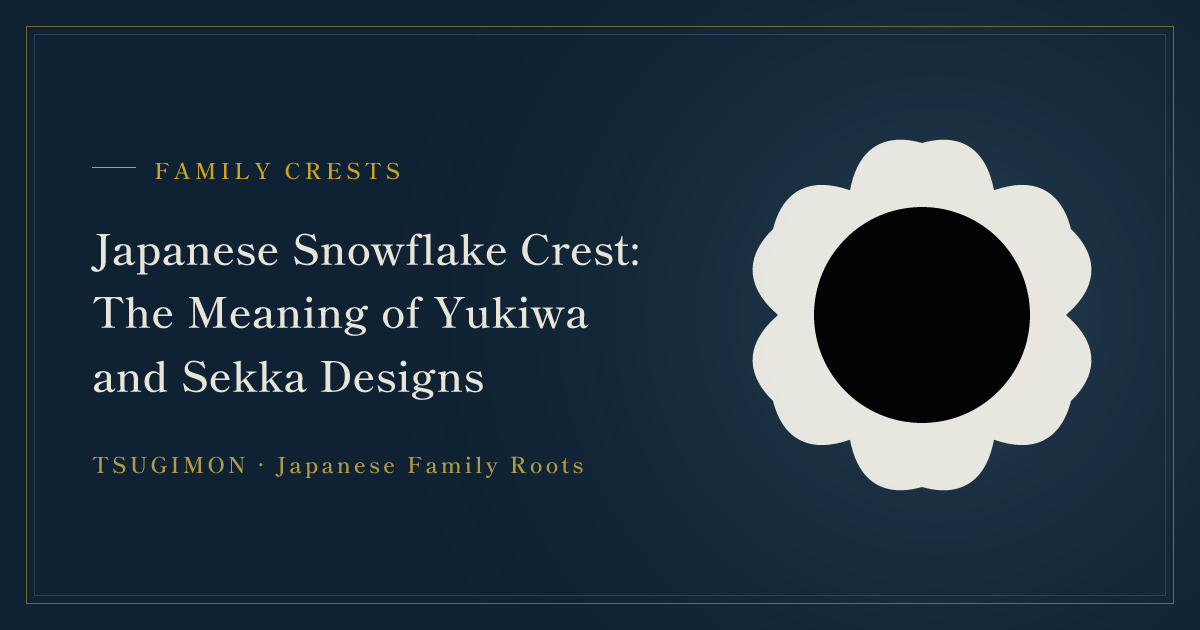
What shape comes to mind when you think of a snow crest?
Among Japanese family crests, there are beautiful designs based on snow. The best known is the yukiwa (雪輪), or "snow ring." It is a round ring with six soft notches along its edge.
In this article, we look at yukiwa and other snow crests, what they mean and where they come from.
What is a yukiwa crest?
A kamon (家紋) is a family crest — a symbol a Japanese family uses on formal kimono, gravestones and belongings. For a broad overview, see our guide to Japanese family crest types.
A yukiwa draws a snow crystal as a rounded ring. Snow crystals branch out in six directions, so the notches around the edge also number six.
Common forms
- Yukiwa (雪輪) — the ring shape on its own.
- Yukiwa ni ... (雪輪に〜) — a yukiwa with another design inside, such as bamboo grass or a flower.
- Sekka (雪華) — a snow crystal drawn in fine detail.
A yukiwa is sometimes used as an outer frame around another crest. Using a snow ring instead of a plain circle gives a softer, more elegant look. We explain more about frames and outlines in our article on Japanese crest variations.
A popular kimono pattern too
Yukiwa has long been loved not only as a crest but also as a kimono pattern. When a yukiwa is drawn on a summer kimono or a yukata — a light cotton summer robe — it looks cool to the eye. Enjoying an image from the opposite season like this is a very Japanese kind of playfulness.
How to check your family crest
The name and feel of a yukiwa change depending on the number and depth of the notches and what is drawn inside. If you think your crest might be a yukiwa, look in these places:
- On the family gravestone or the flower holders in front of it.
- On the butsudan (仏壇), the household Buddhist altar, on ihai (位牌) memorial tablets, or on items used for memorial services.
- On the back of formal mourning clothes or a mon-tsuki kimono — a formal kimono marked with the family crest.
- By asking your parents, grandparents or other relatives.
If the crest is a yukiwa framing another design, note both parts: the frame and what sits inside. When you look the crest up later, you will usually need both names.
When you photograph it, shoot from straight in front. Move close enough that you can see what is drawn inside the ring.
For readers outside Japan, crests may survive on a grandparent's gravestone abroad, on a kimono passed down in a trunk, or in old wedding photos where formal crested clothes were worn.
What snow meant to people in Japan
Snow did not only stand for the harshness of winter.
There has long been a saying in Japan that snow is a sign of a good harvest. When plenty of snow fell in winter, the melting snow in spring would water the rice fields, and the year was expected to bring a rich crop.
For that reason, it is said that snow crests carry a wish for abundance and a good harvest. Some people also feel a sense of purity in the clean whiteness of snow.
Snow also holds a special place in Japanese ideas of beauty. The classic phrase setsugekka (雪月花), "snow, moon and flowers," names three images that have long stood for the beauty of the changing seasons in poetry and art. A snow crest carries a little of that feeling.
However, the meaning of a crest depends on each family's own history. What we describe here is one of the feelings people have connected with snow as an image, not a rule for every family.
Snow crystals and the Edo period
Detailed snow-crystal patterns became popular in the later part of the Edo period (1603–1868).
One figure often credited with this is Doi Toshitsura, lord of the Koga domain (in today's Koga City, Ibaraki Prefecture). Toshitsura observed snow crystals through a microscope and, in 1832, published his findings in a book called Sekka Zusetsu (雪華図説), "Illustrated Snow Crystals."
It is said that the crystal shapes in this book won attention and became fashionable as patterns on clothing and everyday items. The soft yukiwa and the detailed sekka both preserve the gaze of people who found snow beautiful.
Frequently asked questions
Which families use the yukiwa crest?
The yukiwa does not belong to one particular family. Crests were chosen family by family, and even people with the same surname often have different crests. To know whether your family uses a yukiwa, check gravestones, crested kimono and similar items.
What is the difference between yukiwa and sekka?
A yukiwa draws a snow crystal softly as a round ring. A sekka draws the crystal itself in detail, down to each branch.
Is a snow crest a sign that my ancestors lived in a snowy region?
Not necessarily. Families chose crests for many reasons, including taste, meaning and ties to other households. A snow crest alone cannot tell you where your ancestors lived, so combine it with family records and stories.
A small step for today
Look at the family gravestone or the back of a crested kimono. If the ring around the design has notches along its edge, it may be a yukiwa. Take a photo so you have it on record. To see crests often found with your surname, try our tool to look up crests by surname (in Japanese).
Written by Tsucchi, TSUGIMON
The TSUGIMON family-tree reading is currently in Japanese. Your browser's translate feature works well with it, and it takes about three minutes. Free, no sign-up.