TSUGIMON
Japanese Wave Crest Meaning: Nami-mon and the Seigaiha Pattern
Discover the Japanese wave crest meaning, from rising tatsunami waves to the seigaiha pattern, Saito Dosan's crest, and how to identify your own.
Waves come in, pull back and never stop. People in Japan have long seen many wishes in that endless movement.
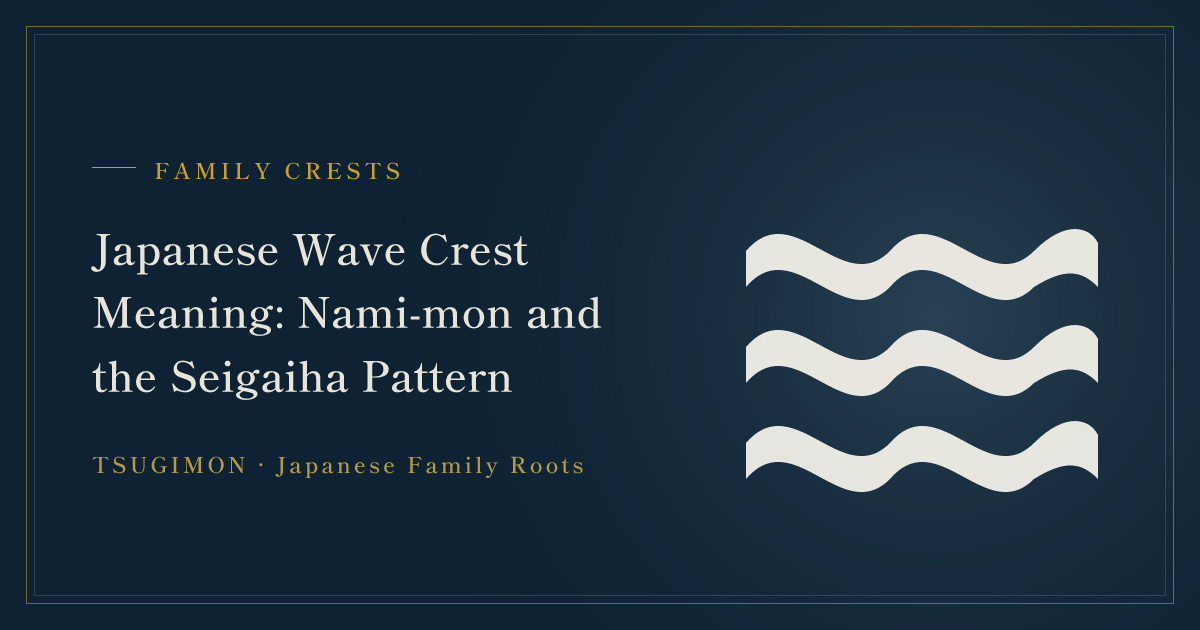
Among Japanese family crests, there is a group called nami-mon (波紋), or wave crests. They show the waves of the sea or a river. In this article, we look at wave crests and at a famous wave pattern called seigaiha.
One note on the word: in everyday Japanese, the same kanji 波紋 can also be read "hamon," meaning ripples spreading on water. In the world of crests, it is read "nami-mon" and means a wave design.
What is a wave crest?
A kamon (家紋) is a family crest — a symbol a Japanese family uses on formal kimono, gravestones and belongings. If you are new to crests, our guide to Japanese family crest types is a good starting point.
A nami-mon is a crest built around the shape of a wave. Some show waves alone. Others combine waves with another image.
Common forms
- Tatsunami (立浪) — a wave rising high. It has a powerful feel.
- Nami ni chidori (波に千鳥) — chidori, small shorebirds, flying over the waves.
- Nami ni usagi (波に兎) — a rabbit leaping over the waves.
- Maru ni nami (丸に波) — a wave enclosed in a circle.
The number of splashes and the thickness of the lines can change the look a great deal. Even two crests both called tatsunami can differ in small details from family to family.
Saito Dosan's "two rising waves"
One well-known figure linked to a wave crest is Saito Dosan, a daimyo — a regional warlord — of Mino Province (the southern part of today's Gifu Prefecture) during the Sengoku, or Warring States, period (roughly the late 1400s to the late 1500s).
It is said that Dosan used a crest called nito-tatsunami (二頭立波), showing two rising waves. A wild, surging wave seems a fitting symbol for a warlord who lived through such turbulent times. You can read about other crests from this era in our article on samurai family crests of the Sengoku warlords.
The meaning of seigaiha
The most famous wave design in Japan is seigaiha (青海波). It is made of overlapping half circles arranged like fish scales. Many people have seen it on kimono, Japanese sweets, tableware and wrapping paper, even outside Japan.
Once you know it, the pattern is easy to spot: rows of nested arcs, each row tucked neatly behind the one in front, like waves rolling toward the shore.
Where the name comes from
It is said that the name seigaiha comes from the title of a piece of gagaku (雅楽). Gagaku is an ancient form of music and dance that has been passed down at the imperial court and elsewhere.
According to tradition, the costumes worn to dance this piece had a wave pattern. In time, the pattern itself came to be called seigaiha.
The wish behind it
Seigaiha shows calm waves stretching on forever. Because of this, it has been treated as an auspicious, or lucky, pattern carrying the wish that "a peaceful life may continue forever."
Seigaiha has been used more widely as a monyo (文様) — a repeating decorative pattern on fabric or tableware — than as a family crest. Still, some families do use seigaiha as their crest.
How to check your own family crest
Wave crests change their names based on small details like splashes or birds. If you want to know what your crest is, look around you:
- On the family gravestone or the flower holders in front of it.
- On the butsudan (仏壇), the household Buddhist altar, or on ihai (位牌) memorial tablets.
- On the back of formal mourning clothes or a mon-tsuki kimono — a formal kimono marked with the family crest.
- By asking your parents, grandparents or other relatives.
Taking a photo will help when you compare your crest with reference books or websites later.
Also, a wave crest does not mean your family came from the coast. Families often chose crests based on taste or on ties to another household. Even families with the same surname often have different crests.
It can be interesting to compare crests with relatives. If the direction of the wave or the shape of the splashes is slightly different, the design may have been changed when a branch family split off.
For readers outside Japan, crests often survive in places like a grandparent's gravestone, a kimono kept in storage, lacquered boxes, or the formal clothes visible in old wedding photos. Relatives in Japan may also recognize the crest from the family grave.
Frequently asked questions
How do you read 波紋 when it means a family crest?
It is read "nami-mon." The reading "hamon" means ripples on the surface of water, which is a different word. Nami-mon is the general name for crests based on sea or river waves.
Is seigaiha a lucky pattern?
Because it shows calm waves continuing endlessly, seigaiha has been considered an auspicious pattern expressing the wish for a peaceful life that lasts. It often appears on kimono and celebratory items.
Can I use the seigaiha pattern if I am not Japanese?
Seigaiha is a widely used decorative pattern rather than one family's private symbol, and it appears on many everyday goods. A specific family's crest is more personal, so it is thoughtful to learn its background before using it.
A small step for today
When you find your family crest on a gravestone or kimono, look closely at the number of splashes and whether a bird appears. To see crests often found with your surname, try our tool to look up crests by surname (in Japanese).
Written by Tsucchi, TSUGIMON
The TSUGIMON family-tree reading is currently in Japanese. Your browser's translate feature works well with it, and it takes about three minutes. Free, no sign-up.