TSUGIMON
Japanese Family Crest Karigane: The Wild Goose of the Sanada Clan
The karigane wild goose Japanese family crest explained: the Sanada clan's knotted goose, Shibata Katsuie's two geese, the goose as messenger, and variations.
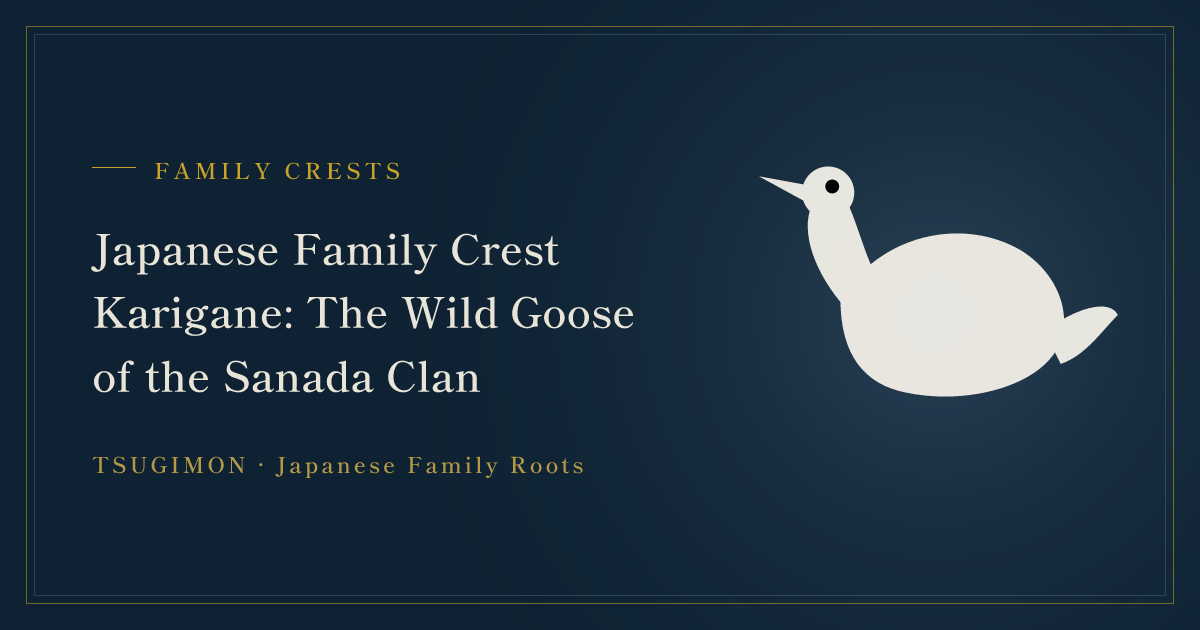
The karigane-mon (雁金紋) is a Japanese family crest shaped like a wild goose, the gan or kari (雁). Most versions show the bird in flight with its wings spread, drawn in soft, rounded lines.
It is well known as one of the crests of the Sanada (真田) clan, who used the musubi-karigane (結び雁金), the "knotted wild goose."
What is the wild goose crest?
Wild geese fly to Japan from the north in autumn and return in spring. Their V-shaped formations crossing the sky have long been a classic image of the Japanese autumn.
The word karigane is said to have first meant the cry of the wild goose, and later came to mean the bird itself. It is sometimes written 雁が音, "the sound of the goose."
There are traditions about why the goose was a fitting emblem:
- A messenger bird: in an old Chinese story, a man held captive far away tied a letter to a goose's leg to send word home. From this, a letter came to be called gansho (雁書), a "goose letter."
- A bird that keeps its season: because geese return at the same time each year, some see them as a symbol of keeping promises.
These are traditions and ways of seeing, not facts about any family. Still, a bird that links people far apart seems a fitting image for a family symbol, especially for families whose members now live across oceans.
A kamon (家紋), the family crest, is a design passed down in a household and shown on gravestones, formal kimono, and heirlooms. For an overview, see Japanese family crest types.
The Sanada clan and other families
The Sanada clan's knotted goose
The Sanada clan is most famous for the rokumonsen (六文銭), "six coins," also called rokurensen. It shows six coins in two rows and is well known as the banner of Sanada Yukimura, also known as Nobushige, a celebrated warrior of the early 1600s. You can read about other warlord crests in samurai family crests of the Sengoku warlords.
But the Sanada did not use only the six coins. They also used the musubi-karigane and a crest called suhama (州浜), and are said to have used different crests for different occasions.
The musubi-karigane draws the goose's neck and wings as if they were tied in a knot of cord. The result is a compact, rounded shape with a gentle sense of movement. Next to the bold six coins, it has an almost charming look.
Knowing that one family could hold several crests with very different moods is a useful reminder. Your family, too, may have more than one crest.
Other families
The Sengoku general Shibata Katsuie (柴田勝家), a senior retainer of Oda Nobunaga, is said to have used futatsu karigane (二つ雁金), "two wild geese," a crest showing a pair of geese.
Many other families used goose crests as well. Having a goose crest does not mean your family is connected to the Sanada or Shibata.
The Sanada are a good example of how crests were used in practice. A samurai family often had a main crest, used on formal occasions, and one or more secondary crests, used on everyday items or by certain branches. Some crests were received as rewards from a lord, and some came through marriage. Over generations, a branch family might keep an old crest while the main house adopted a new one.
The same thing could happen in ordinary families. After a family split into a main house and branch houses, each might slightly change the crest, for example by adding a circle. This is one reason two related families can show crests that look similar but not identical. When you compare your family's crest with a relative's, small differences are not a sign of a mistake. They may be part of the family's history.
Types of wild goose crests
- Karigane: a single wild goose, the basic form.
- Musubi-karigane: the goose shaped as if tied in a knot.
- Futatsu karigane: two geese side by side.
- Maru ni versions: any of these inside a circle. "Maru" means circle, a common way to vary a crest.
The number of feathers and the angle of the neck differ from family to family. If your crest is a goose, compare the small details.
Frequently asked questions
Does a goose crest mean my family descends from the Sanada?
Not necessarily. Many families besides the Sanada used goose crests. Crests were chosen family by family, so a crest alone cannot prove your roots.
Did the Sanada use only the six coins?
The six coins are the most famous, but the Sanada are also said to have used the knotted goose and the suhama crest. It was not unusual for one family to use several crests.
Could the bird on my great-grandparent's gravestone abroad be a family crest?
Quite possibly. Many families who emigrated from Japan had their crest carved on their gravestones. Photograph it straight on, note any circle around it, and compare it with crest references or ask relatives in Japan.
A small step for today
Look at a family gravestone, household altar, or old kimono for a bird-like shape with rounded, spread wings. If you find one, it may be a wild goose crest. For tips on where crests usually appear and how to record them, read how to find your Japanese family crest.
Written by Tsucchi, TSUGIMON
The TSUGIMON family-tree reading is currently in Japanese. Your browser's translate feature works well with it, and it takes about three minutes. Free, no sign-up.