TSUGIMON
Japanese Family Crest Ine: Rice Plant Crests and the Suzuki Name
The rice plant Japanese family crest explained: the daki-ine design of two embracing stalks, the Suzuki family of Kumano, Inari belief, and common variations.
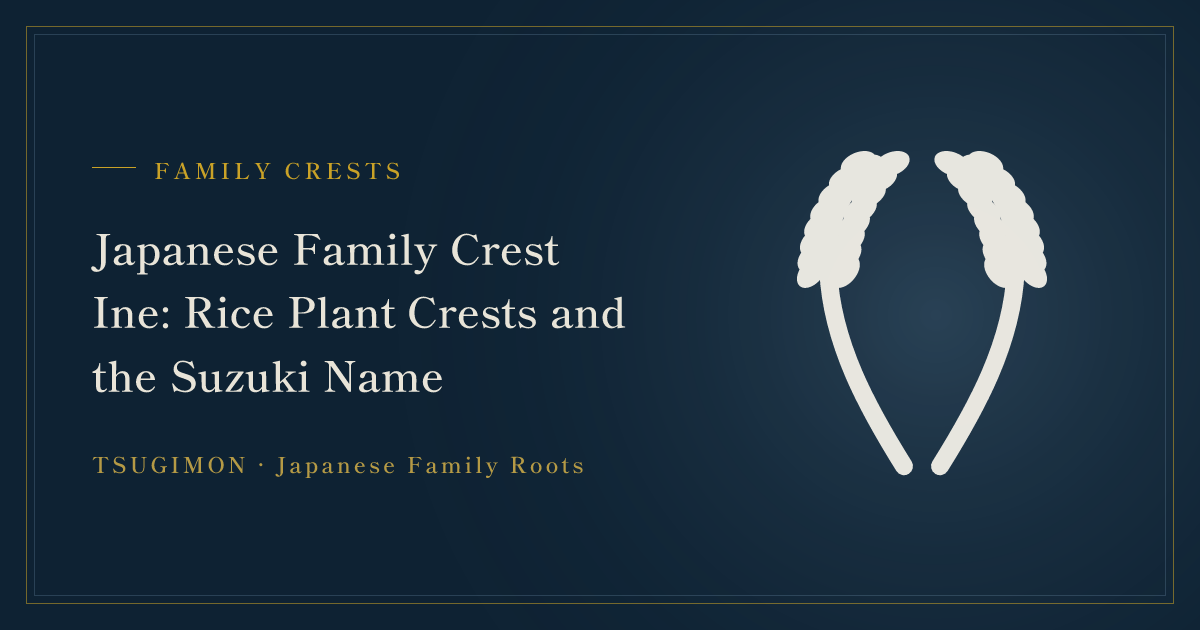
The ine-mon (稲紋) is a Japanese family crest shaped like ripe rice plants. Rice has supported life in Japan for centuries, so the crest is said to carry wishes for a good harvest and prosperity.
The best-known version is daki-ine (抱き稲), "embracing rice," in which two drooping stalks curve toward each other to form a ring.
What is the rice plant crest?
Ine-mon is the general name for crests based on rice. Most show heavy, drooping ears of grain drawn with soft, flowing lines.
In premodern Japan, rice was a measure of wealth. Even the size of a samurai lord's domain was counted in koku (石), a unit of rice. So rice became a natural symbol of abundance and good fortune.
Rice also appears in a well-known Japanese saying: "The more the rice ripens, the lower it bows its head." It means that truly accomplished people stay humble. Some families with rice crests may have valued that meaning too.
A kamon (家紋), the family crest, is a design passed down in a household and shown on gravestones, formal kimono, and heirlooms. For an overview of different kinds, see Japanese family crest types.
The Suzuki family, Inari, and rice crests
The Suzuki family
The family most often associated with rice crests is the Suzuki (鈴木) family connected with Kumano, in Kii Province, today's Wakayama Prefecture south of Osaka.
This Suzuki family is said to have had close ties to the great shrines of Kumano, and rice crests such as daki-ine are well known as its emblem. One theory even says the surname Suzuki itself comes from a local word related to rice sheaves.
The Suzuki name is said to have spread from Kumano to other parts of Japan, which is one reason the rice crest is so often mentioned with it. Today Suzuki is among the most common surnames in Japan. Read more in our article on the Suzuki surname.
But not every Suzuki family uses a rice crest. Crests were chosen family by family, and many Suzuki households have completely different ones.
Rice and Inari belief
Rice is closely tied to Inari (稲荷) belief. Inari is a kami, a Shinto deity, long worshipped as a guardian of the rice harvest. Shrines to Inari are often guarded by fox statues and red torii gates.
One theory says the name "Inari" comes from "ine nari" (稲成り), "rice ripening."
Some families with rice crests may have felt a connection to Inari and cherished the crest for that reason. Why each family chose its crest, though, is different from family to family.
Rice runs through the Japanese year in many other ways too. Rice cakes called mochi are pounded and eaten at New Year. Freshly harvested rice is offered to the kami at autumn festivals, and many local shrines hold rites for planting and harvest. Sake, made from rice, is offered at shrines and shared at weddings and celebrations. For families who farmed, the rhythm of planting in spring and harvesting in autumn shaped the whole household's calendar.
Seen against this background, it is easy to understand why rice became a family emblem. It stood for the most basic hopes a household could have: enough to eat, a good harvest, and a family that would continue. When you look at a rice crest on an old gravestone, you are seeing a symbol of those hopes.
Types of rice crests
- Daki-ine: two rice stalks facing each other and curving into a ring.
- Maru ni daki-ine: daki-ine inside a circle. "Maru" means circle, a common way to vary a crest.
- Hitotsu ine: a single rice stalk.
- Ine no maru: rice stalks curved into a round ring by themselves.
Even with daki-ine, the number of grains and the way the leaves are drawn vary from family to family. If your crest is rice, compare the small details carefully.
Rice crests are sometimes confused with other plant crests. Look for the heavy, drooping ears of grain, drawn as a row of small oval kernels. Wheat or grass designs are rare in crests, so a drooping head of grain is very likely rice. If the stalks curve into a ring with the heads meeting at the top, you are probably looking at a form of daki-ine.
When you find a rice crest, note the details in writing: how many stalks, whether there is a circle, and roughly how many kernels on each ear. Those notes make it much easier to compare with reference books or with a relative's memory later on.
Frequently asked questions
Does a rice crest mean my family name is Suzuki?
No. The rice crest is famous as a Suzuki emblem, but families with other surnames have used it too. It is best to look at the crest and the surname separately.
Is the rice crest a farmer's crest?
Not necessarily. Rice was a symbol of prosperity, and families of the samurai class also used rice crests. The crest does not tell you your ancestors' occupation.
We are a Japanese American family named Suzuki. How can we find our crest?
Look for it on family gravestones, a butsudan (仏壇), the household Buddhist altar, and old formal kimono or wedding photos. Relatives in Japan may know the crest on the family grave there. If nobody knows, that is common, and the search itself can become a family project.
A small step for today
Ask an older relative a simple question: "Do you know what our family crest looks like?" Even a vague answer such as "I think it was rice" is a valuable clue. For gentle ways to start that conversation, read interviewing grandparents about family history.
Written by Tsucchi, TSUGIMON
The TSUGIMON family-tree reading is currently in Japanese. Your browser's translate feature works well with it, and it takes about three minutes. Free, no sign-up.