KAKEIZ
Japanese Family Crest Types: Plants, Animals, Nature and More
A beginner's guide to Japanese family crest types, grouped by motif: plants, animals, nature, objects, patterns and characters, with the wishes behind each.
Look at a few Japanese family crests and you will notice how varied they are. Some show flowers or birds. Others show waves, the moon, a folding fan or arrows.
A Japanese family crest is called kamon (家紋). It is a small emblem a family has used for generations on its clothing, belongings and graves. There are so many crests that some say there are several thousand, or even more.
That can feel overwhelming. But if you sort crests by what they show, called the motif, they become much easier to understand. This guide follows a commonly used way of grouping them. Different books and researchers group crests a little differently, so treat this as one helpful map, not a fixed rule.
Plant and animal crests
Plant crests
Plant crests are said to be the largest group of all. Here are some you will often see:
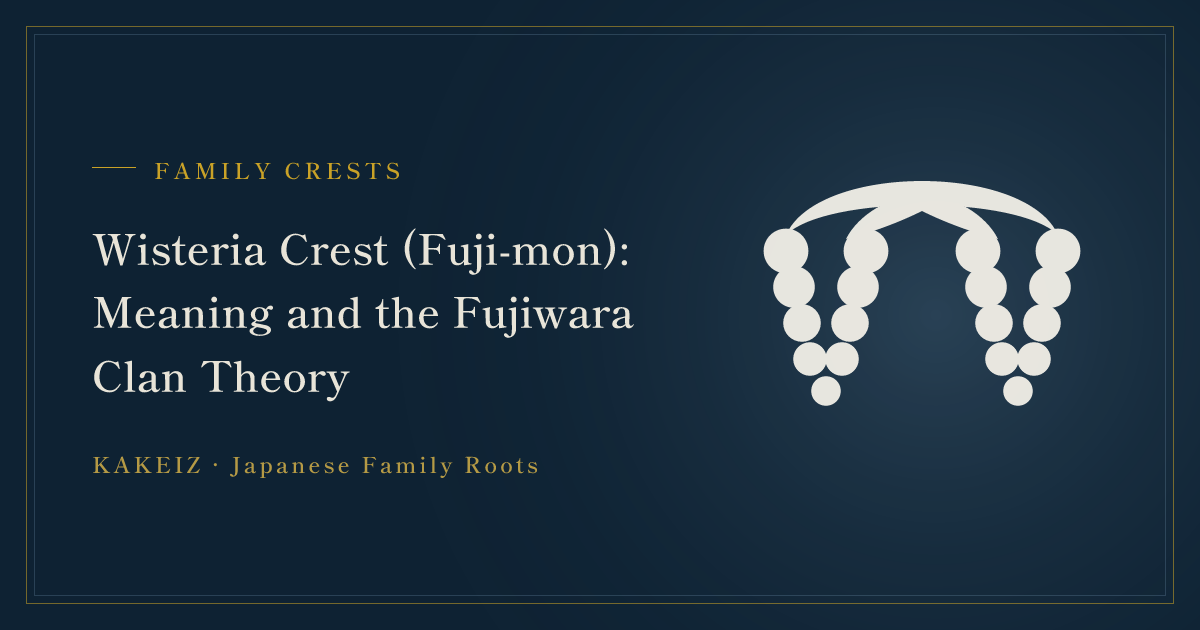
- Fuji (藤), wisteria … Hanging clusters of flowers. It is sometimes linked to the Fujiwara, a powerful noble clan of old Japan.
- Kiri (桐), paulownia … Three leaves with flower stalks. It has long been treated as a high-ranking crest.
- Mokko (木瓜) … A rounded, lobed shape. Its origin is debated. Some say it shows a cut gourd, others a bird's nest.
- Kashiwa (柏), oak leaf … It is said that these leaves were once used to hold offerings to the gods.
- Kikyo (桔梗), bellflower, ume (梅), plum blossom, and kiku (菊), chrysanthemum are also common.
Why so many plants? One reason may be the way Japanese life has long been shaped by the seasons. Familiar flowers, trees and grasses were natural choices.
Animal crests
These crests show birds, insects, fish and other creatures:
- Takanoha (鷹の羽), hawk feather … Hawk feathers set side by side. It suggests courage.
- Cho (蝶), butterfly … An elegant design. It is sometimes linked to the Taira, a famous warrior clan.
- Kari (雁), wild goose and tsuru (鶴), crane … A migrating bird and a bird of long life.
- Tonbo (蜻蛉), dragonfly … There is a story that dragonflies were called "victory insects" because they only fly forward.
Animal crests are much less common than plant crests. That makes them stand out when you find one.
Nature, object, pattern and character crests
Nature crests
These crests show things from the sky, the land and water. They are also called tenmon-mon (天文紋), or "heavenly body crests."
- Sun, moon and stars … Some crests, such as kuyo (九曜), arrange several stars together.
- Clouds and mist
- Waves and water … Such as seigaiha (青海波), a pattern of overlapping waves.
- Mountains … A simple mountain shape.
To people long ago, the sun, moon and stars were also objects of faith. It is said that this feeling shows up in these crests.
Object crests
These crests, called kibutsu-mon (器物紋), show tools from daily life and ceremony:
- Ogi (扇), folding fan and uchiwa (団扇), flat fan
- Arrows and bows
- Keys and metal rings
- Igeta (井桁) … The square frame around the top of a well.
Many of these are tools linked to samurai, the warrior class, or tools used in Shinto rituals.
Pattern crests
These crests are built from shapes themselves:
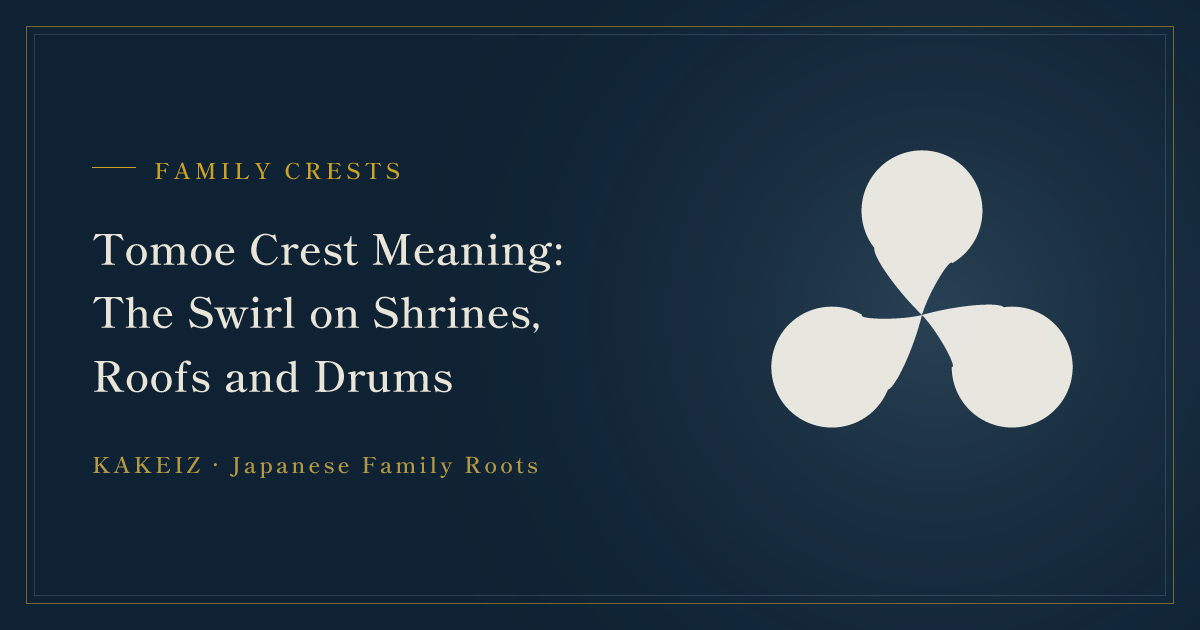
- Tomoe (巴) … A swirling comma shape. The mitsudomoe, with three swirls, is especially well known.
- Hishi (菱) … Diamond shapes in combination.
- Wachigai (輪違い), interlocking rings, and kikko (亀甲), a hexagon based on a tortoise shell.
Character crests
Some crests turn a written character into a design. Simple kanji such as 一 (one), 十 (ten), 大 (great) and 上 (above) are examples.
One motif, many crests
Even within one motif, there are many different crests. Families created new versions by changing details:
- Placing the design inside a circle, as in "maru ni ..." which means "within a circle"
- Changing the number, such as two, three or five
- Changing the direction or the combination
- Making the lines thicker or thinner
There is a story that branch families added a ring to the main family's crest when they split off. But how it happened in any one family varies from family to family. Our guide to crest variations like maru and kage explains these terms in more detail.
If you are curious about which designs are used most widely, see the five most common Japanese family crests.
For families living outside Japan, knowing the motif group is a practical first step. If you find a crest on a grandparent's gravestone or on an old kimono, you may not know its name. But you can usually tell whether it is a plant, a bird, a shape or a character. That alone narrows your search a great deal.
Frequently asked questions
How many Japanese family crests are there in total?
There are a great many, with estimates of several thousand or more. Families created new versions by adding a circle, changing the number of elements or turning the design. The total also depends on how you count these variations.
What is the most common type of crest?
Plant crests are said to be the most numerous. Wisteria, paulownia, mokko, oak leaf and bellflower are all common. Their popularity may reflect a way of life that paid close attention to the seasons.
I found a crest but do not know its name. What should I do?
First, decide which motif group it belongs to: plant, animal, nature, object, pattern or character. Then note the details, such as a surrounding ring or the number of leaves. Showing a clear photo to relatives, or comparing it with crest images by eye, can help you find the name.
A small step for today
Think about your family's crest, if you have seen it on a grave, a kimono or a family altar. Which motif group does it belong to? If you do not know your crest yet, you can look up crests by surname on our crest page. The page is in Japanese, but you can browse the crest images by eye.
Written by Tsucchi, KAKEIZ
The KAKEIZ family-tree reading is currently in Japanese. Your browser's translate feature works well with it, and it takes about three minutes. Free, no sign-up.