KAKEIZ
Japanese Crest Variations: What Maru ni, Sumitate and Kage Mean
A plain guide to Japanese crest variations: what maru ni, sumitate, kage and chukage mean, how they change a crest's name, and how to read your family's crest.
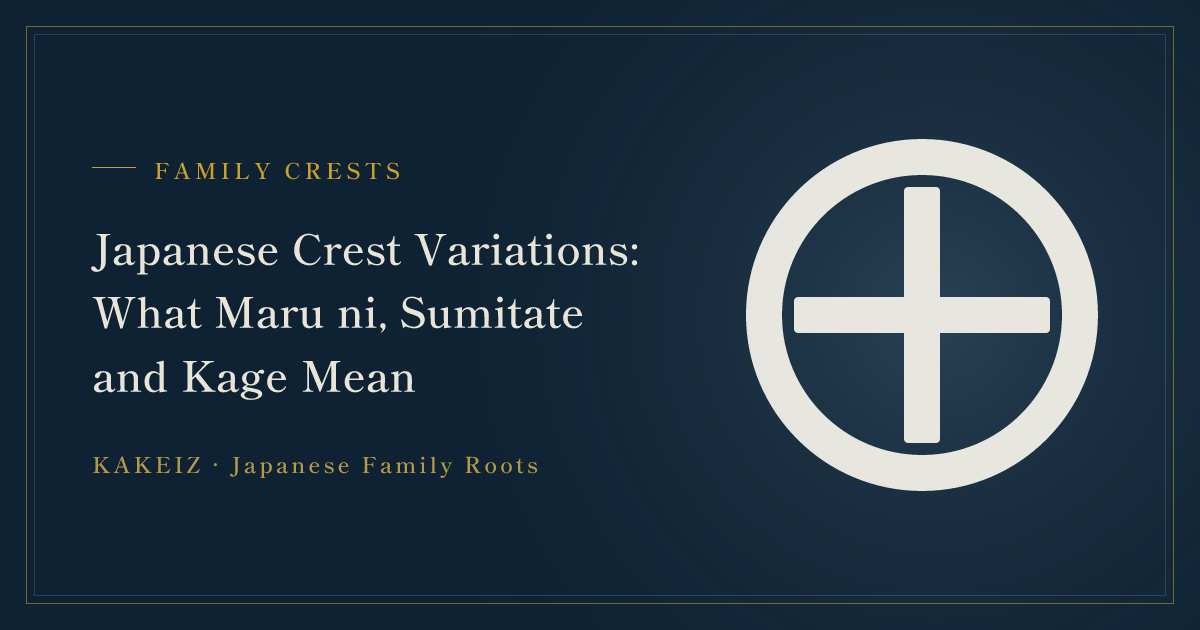
Japanese family crest names often have extra words in front. You may see names like "maru ni tachibana," "sumitate yotsume" or "kage tsuta." These words describe how the basic crest is drawn.
A Japanese family crest is called kamon (家紋). It is a small emblem used for generations on a family's clothing, belongings and graves. Once you learn a few of these descriptive words, long crest names become much easier to read.
In short, "maru ni" means the crest sits inside a ring. "Sumitate" means a square shape is turned so a corner points up. "Kage" means the crest is drawn in outline only.
Maru ni: inside a ring
The most common prefix is maru ni (丸に), which means "within a circle." It describes a crest with a ring drawn around the original design.
The thickness of the ring changes the name:
- Futowa (太輪) … A thick ring
- Chuwa (中輪) … A ring of medium thickness
- Hosowa (細輪) … A thin ring
- Itowa (糸輪) … A ring as thin as a thread
Rings are not the only frame. A crest can also sit inside a square, called kaku (角), a hexagon, called kikko (亀甲), or a snowflake-shaped ring, called yukiwa (雪輪).
Why add a ring? A common story says that branch families added one to tell themselves apart from the main family. But this was not a rule. Families may also have added a ring to balance the design, or to make it look better on a kimono. The reasons likely varied from family to family.
Sumitate: a corner pointing up
Sumitate (隅立て) means "corner standing." It describes a square-based crest turned so that one corner points straight up. The result looks like a diamond.
Take the crest called yotsume (四つ目), "four eyes," which is made of four small squares:
- Hira yotsume (平四つ目) … The squares sit flat, with a side on top.
- Sumitate yotsume … The squares are turned so a corner is on top.
The same four squares become two different crests just by how they are placed. When you see a crest built from squares, check whether a side or a corner is at the top.
Kage and chukage: outline and fill
Crests also differ in how they are filled in:
- Hinata-mon (日向紋) … The basic style. The shape is shown as a solid white form.
- Kage-mon (陰紋) … Only the outline of the shape is drawn in a fine line.
- Chukage (中陰) … Also an outline, but with a thicker line than kage-mon.
On kimono, the hinata-mon is considered the most formal. Kage-mon has traditionally been used for slightly less formal occasions, and chukage falls in between.
There is also a style called kokumochi (石持). Here, a plain white circle is left on the fabric so that a crest can be painted in later. You may see this on kimono bought ready-made.
How the words combine
These words are combined to build a full name. For example, "maru ni sumitate yotsume" means four squares, turned corner-up, inside a ring.
If you read the name from front to back, the shape appears in your mind.
Here are a few more words you will often see in crest names:
- Mitsumori (三つ盛り) … Three of the same shape, stacked like a small mountain
- Mukai (向かい) … Two of the same shape facing each other
- Daki (抱き) … Two leaves or stalks curving in from both sides, as if embracing
- Chigai (違い) … Two shapes crossed diagonally
You will see them in names like "daki myoga," two curved stalks of Japanese ginger, or "chigai takanoha," two crossed hawk feathers.
Long names do not need to be scary. Break the name into four parts: the frame, the placement, the fill, and the base crest. With that order, you can picture most crests.
For overseas families, this is very practical. If you photograph a crest on a grandparent's gravestone or on an old kimono, you can describe it even before you know its name. Is there a ring? Is a corner on top? Is it only an outline? Those three answers will help any relative or reference book identify it. To learn about the base designs themselves, see our guide to Japanese family crest types.
Frequently asked questions
Is a crest with "maru ni" a different crest from one without?
They come from the same base design, but they are treated as separate crests. When you have a crest made for a gravestone or a kimono, it is safest to match whether there is a ring or not.
Is it rude to use a kage-mon?
No. A kage-mon is simply considered a less formal style than a hinata-mon. Which style a family uses can also depend on the region and the household.
How can I find the correct name of my family's crest?
Photograph the crest on a grave, family altar or old kimono. Check three things: is there a ring, is a corner on top, and is it outline only? Then read it in order of frame, placement, fill and base crest. Comparing it with a relative's crest can also help.
A small step for today
Take a photo of the crest on a family grave, altar or old kimono, and check the three points: a ring, a corner on top, or outline only. If you do not know the name of the base crest, you can look up crests by surname on our crest page to find similar shapes. The page is in Japanese, but you can compare the images by eye.
Written by Tsucchi, KAKEIZ
The KAKEIZ family-tree reading is currently in Japanese. Your browser's translate feature works well with it, and it takes about three minutes. Free, no sign-up.