KAKEIZ
Wisteria Crest (Fuji-mon): Meaning and the Fujiwara Clan Theory
The wisteria crest, or fuji-mon, shows hanging wisteria blossoms. Learn its meaning, the Fujiwara clan theory, and how to tell sagari-fuji from agari-fuji.
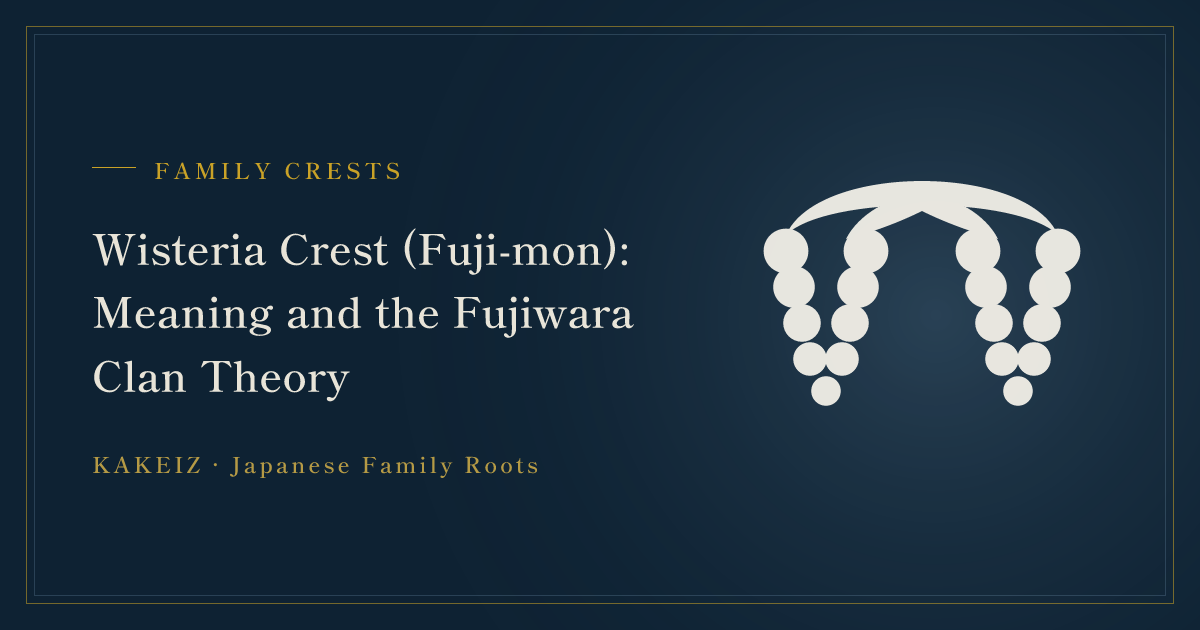
The fuji-mon (藤紋), or wisteria crest, shows the long hanging flower clusters and leaves of the wisteria plant. It is one of the most widely used kamon (家紋), the family crests passed down in Japanese households.
The best-known form is sagari-fuji (下がり藤), the "hanging wisteria," in which two flower clusters curve around to form a ring. A well-known theory says the crest spread across Japan along with the Fujiwara, a powerful noble clan of the Heian period (794–1185).
What the wisteria crest looks like
Wisteria blooms in late spring, sending down long clusters of purple flowers. In Japan, people walk beneath wisteria trellises to enjoy them, much as people elsewhere enjoy cherry or apple blossoms.
The plant climbs by winding its vines around trees and frames, and it keeps growing for many years. Its long clusters, with countless flowers opening at once, have been loved for centuries. Wisteria appears often in classical Japanese poetry and stories.
The basic crest arranges two clusters from left and right into a round shape.
- Sagari-fuji (下がり藤), hanging wisteria — the clusters hang downward. This is the standard form.
- Agari-fuji (上がり藤), rising wisteria — the clusters point upward.
There are many more versions: wisteria inside a circle, wisteria with a character or another design in the center, and clusters swirled into a pinwheel shape. The wisteria crest is one of the classic Japanese family crests. You can learn about other common designs in the five most common Japanese family crests.
The Fujiwara connection: a theory, not a rule
The Fujiwara clan and the wisteria
The Fujiwara clan began in the 600s, when a court official named Nakatomi no Kamatari was given the name "Fujiwara." The name literally contains the character for wisteria, fuji (藤). During the Heian period, the Fujiwara held enormous power at the imperial court.
The wisteria crest is said to be one of the crests used by Fujiwara families. Because the clan's name contained "wisteria," it is said they held the flower dear. The idea is that other families later adopted the crest, hoping to share in the Fujiwara's good fortune.
However, nobody knows exactly which family first used wisteria as a crest, or when. Wisteria was already a common pattern on clothing in the Heian period. The pattern most likely became a family crest slowly, over a long time.
The wisteria of Kasuga Taisha
Kasuga Taisha, a shrine in Nara, is known as the shrine of the Fujiwara's ujigami (氏神), the guardian deity of the clan. Its shrine crest is also the hanging wisteria, and it is thought that the Fujiwara crest was taken into the shrine.
Hanging and rising wisteria
The original form is the hanging wisteria, because real wisteria flowers hang down.
On the other hand, the word sagaru (to hang, to go down) can also suggest decline. It is said that some people felt this was unlucky, so the rising wisteria was created with the clusters pointing up.
Neither form is better or worse. Each family chose its shape and put its own feelings into it.
Families with their own wisteria crests
Some wisteria crests carry a family name.
- Kuroda fuji-domoe (黒田藤巴) — a crest linked to the Kuroda family, with clusters swirling like a tomoe, the comma-shaped swirl seen on many shrines.
- Ōkubo fuji (大久保藤) — a rising wisteria with the character 大 ("great") inside.
In this way, families changed the design a little to make it their own.
In the Edo period (1603–1868), crests spread beyond the samurai class, the warrior class that ruled Japan, to merchants and farmers. The wisteria crest was taken up by many households and is now very common.
Reading a wisteria crest in your family
If a wisteria crest appears on a family grave, an old kimono, or the butsudan (the household Buddhist altar), take your time and look closely. Small details are what make one family's wisteria different from another's. Check four things: Do the clusters hang down or rise up? Is there a circle around it? Is there a character or design inside? Are the clusters swirled?
For readers outside Japan, the same checklist works on a gravestone in Hawaii, California, Brazil or anywhere a Japanese family settled. A clear photo is worth more than a written description, because small differences matter. If you have relatives in Japan, sending them the photo and asking what they call the crest can open up a whole conversation about family history.
Frequently asked questions
If our surname has "fuji" in it, are we Fujiwara descendants?
There is a theory that names with the character 藤, such as Sato, Kato and Ito, are linked to the Fujiwara. But a surname alone cannot prove a bloodline, and every family's origin is different. See Japanese surnames with fuji for more on this theory.
Does a wisteria crest mean our family descends from the Fujiwara?
Not necessarily. The wisteria crest was used by a great many families. Some families do pass down a Fujiwara connection, but a crest alone cannot decide it.
How can I tell hanging wisteria from rising wisteria?
Look at which way the clusters point. If they hang down, it is sagari-fuji. If they point up, it is agari-fuji. Then check for a circle or a character inside to narrow down your family's exact version.
A small step for today
Think about whether your surname, or the surname of any relative, contains the character 藤. If you find one, it can be a nice starting point for learning where that name came from. To begin with the crest side, try the crest lookup by surname (in Japanese).
Written by Tsucchi, KAKEIZ
The KAKEIZ family-tree reading is currently in Japanese. Your browser's translate feature works well with it, and it takes about three minutes. Free, no sign-up.