KAKEIZ
Tomoe Crest Meaning: The Swirl on Shrines, Roofs and Drums
Tomoe crest meaning explained simply: the swirling comma shapes, theories of their origin, the link to Hachiman, and why they appear on roof tiles and drums.
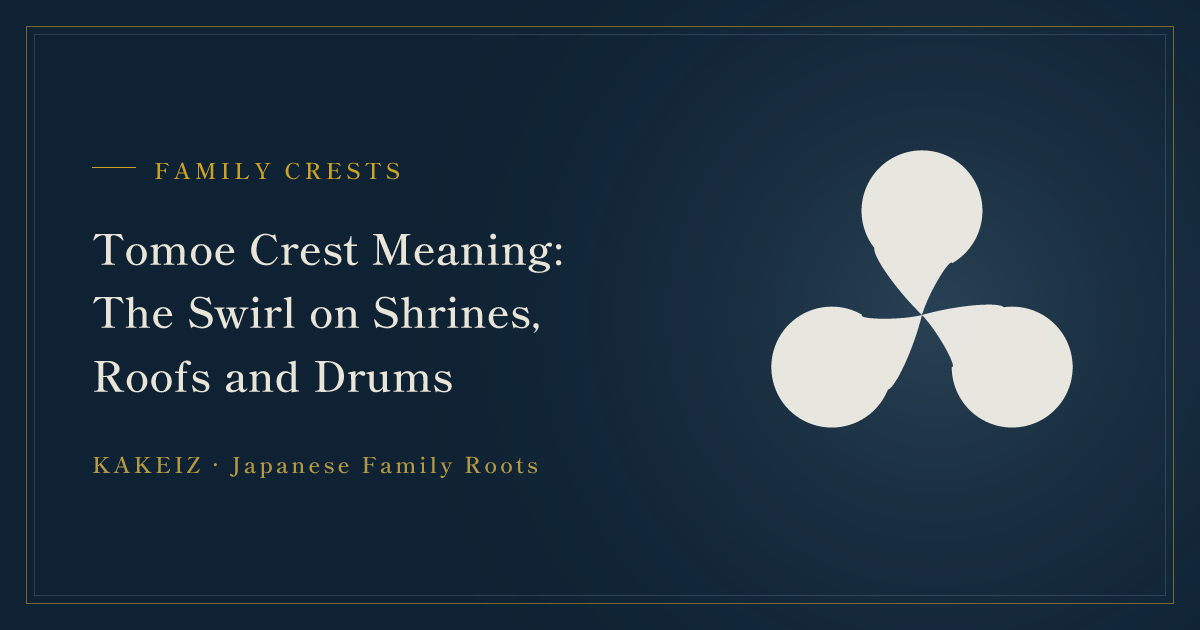
The tomoe-mon (巴紋), or tomoe crest, is made of comma-like shapes that swirl around a center, a bit like the magatama (勾玉), the curved jewels of ancient Japan. It is one of the kamon (家紋), the family crests passed down in Japanese households.
Even if you have never seen a family crest, you may have seen a tomoe. It appears on shrine curtains, on the round end tiles of temple and shrine roofs, and on the big taiko drums used at festivals. Its origin is not settled, and there are several theories. It is also well known as the crest of Hachiman, a Shinto god.
What the tomoe crest looks like
The crest combines tadpole-like shapes called tomoe. Its name changes with the number of shapes.
- Hitotsu-domoe (一つ巴) — a single tomoe.
- Futatsu-domoe (二つ巴) — two tomoe facing each other.
- Mitsu-domoe (三つ巴) — three tomoe circling in a ring. This is the most common form.
There are many more versions, such as maru ni mitsu-domoe, a three-tomoe crest inside a circle.
The direction of the swirl gives us "right mitsu-domoe" and "left mitsu-domoe." Be careful, though: different sources sometimes use "right" and "left" in opposite ways. When recording your family's crest, a photo is safer than the name alone.
Where the tomoe comes from: three theories
No one knows for certain how the tomoe began. Here are the main theories.
The archer's wrist guard
A tomo (鞆) was a round leather guard worn on the left wrist when shooting a bow. One theory says the pattern drawn on it was called tomo-e (鞆絵), "tomo picture," and that this became "tomoe."
The magatama jewel
Another theory says the crest is a drawing of the magatama, a comma-shaped jewel worn in ancient Japan.
A whirlpool of water
A third theory says the shape shows water swirling in a whirlpool. The Chinese character used for tomoe, 巴, is said to have been chosen because its shape looked similar.
Some researchers also think the tomoe on festival drums stands for thunder. In this reading, the boom of the drum is the thunderclap, the round head of each tomoe is where the drum is struck, and the tail shows the sound flying away.
None of these theories has been proven. The tomoe may have reached its present form slowly, with several meanings layered on top of one another.
Hachiman, fire, and the families who used it
The crest of Hachiman
The tomoe became the shrine crest of Hachiman (八幡), a god worshiped as a protector of warriors. From there it is said to have spread to other shrines.
Because the samurai, the warrior class of old Japan, held Hachiman in high regard, many warrior families took the tomoe as their crest. It is said that several hundred families serving the Tokugawa shogunate (1603–1868) used it.
A wish against fire
Because the tomoe was thought to be linked to water, it was placed on the round end tiles along the eaves of old buildings, as a wish for protection from fire. Look up at the roof of a temple or shrine in Japan and you may still see a row of tomoe tiles.
The tomoe on festival drums, especially those used at shrine events, is said to combine several ideas: the link to Hachiman and the meanings of thunder and water.
These were the hopes and beliefs of people long ago. Putting a tomoe on a roof does not actually prevent fires.
People who used the tomoe
- The Utsunomiya and Akamatsu families, among many warrior families across Japan.
- Hijikata Toshizō, vice commander of the Shinsengumi, a famous police force in Kyoto in the 1860s. He is said to have used a left mitsu-domoe.
- The royal family of the Ryukyu Kingdom, in today's Okinawa, which used a left mitsu-domoe.
From warrior houses to a royal family, the tomoe was used very widely. Its simple shape fits neatly inside a circle, which may be one reason people liked it. Many families made small changes, adding more tomoe, placing them in a circle, or putting another design inside. To learn more about how crests are grouped, see types of Japanese family crests.
Spotting a tomoe in your family history
The tomoe is easy to recognize, which makes it a good crest to look for in old family belongings. Check the gravestones of grandparents or great-grandparents, old formal kimono with small crests on the back and sleeves, and a butsudan, the household Buddhist altar. If your family has roots in Okinawa, you may notice the left mitsu-domoe there too, but a crest alone does not show any royal link.
When you find one, count the tomoe, note the direction of the swirl, and check for a circle. Then ask relatives, in Japan or nearby, what they call it.
Frequently asked questions
Does the "three" in mitsu-domoe have a special meaning?
There is no fixed rule. Three swirling shapes look balanced and full of movement, which is likely why the design became so popular.
Does a tomoe crest mean our family is connected to Hachiman?
Not necessarily. Some families chose it because of their faith in Hachiman, and others chose it for different reasons. Every family's story is its own.
How do I tell a right mitsu-domoe from a left one?
They are named by the direction of the swirl. But sources sometimes disagree about which is "right," so keep a photo of your family's crest along with its name. That way the exact design is never lost.
A small step for today
The next time you pass a Japanese temple or shrine, in Japan or abroad, look up at the roof and the drums. You may spot a tomoe. If you are curious about your own family's crest, try the crest lookup by surname (in Japanese).
Written by Tsucchi, KAKEIZ
The KAKEIZ family-tree reading is currently in Japanese. Your browser's translate feature works well with it, and it takes about three minutes. Free, no sign-up.