KAKEIZ
Japanese Family Crest: The Five Most Common Designs Explained
Learn the five most common Japanese family crest designs, the godaimon: wisteria, paulownia, hawk feather, mokko and katabami, and how to find your own.
If you have Japanese roots, you may have seen a small round emblem on a gravestone, on a black kimono, or on the drawer of a family altar. That emblem is a kamon (家紋), the family crest. It is a simple design that a household has used for generations to mark its belongings and its identity.
Japan has a huge number of these crests. Some say there are several thousand. If you count every small variation, some say there are more than twenty thousand.
Out of all of them, a handful are used by a very large number of families. These are known as the godaimon (五大紋), the "five great crests." If you are just starting to learn about your family's crest, these five are a good place to begin.
The five most common crests
Here are the five designs usually counted as the godaimon. The meanings below are the ones most often told, but for some crests the origin is still debated.
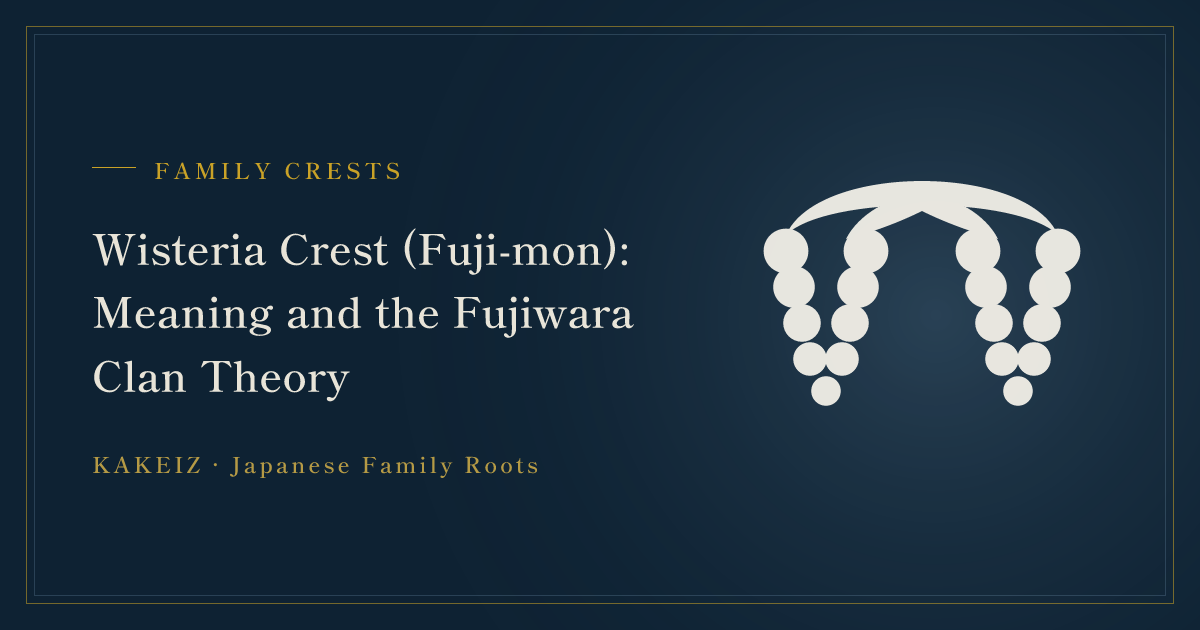
- Fuji (藤), wisteria … This crest shows hanging clusters of wisteria flowers. It is said to be linked to the Fujiwara, a powerful noble clan of old Japan whose name contains the same character.
- Kiri (桐), paulownia … A design of three leaves topped by flower stalks. It was a high-ranking crest that the imperial court granted to families who had served it well. Today a version of it is also used as an emblem of the Japanese government.
- Takanoha (鷹の羽), hawk feather … Hawk feathers turned into a design. Because the hawk suggests courage, it was popular with samurai families.
- Mokko (木瓜) … A rounded design with soft lobes. One theory says it shows a bird's nest. Another says it shows the cross-section of a gourd or melon.
- Katabami (片喰), wood sorrel … A small plant with heart-shaped leaves that grows by the roadside. It spreads easily and its roots are hard to pull out. It is said that families chose it as a wish that their line would never die out.
Sometimes five more designs are added to make the jūdaimon (十大紋), the "ten great crests." These are kashiwa (柏), oak leaves; tachibana (橘), a type of citrus; omodaka (沢瀉), a water plant called arrowhead; myoga (茗荷), a kind of Japanese ginger; and tsuta (蔦), ivy.
You may notice that almost all of these are plants. Plant crests are thought to be the largest group of Japanese crests overall. If you want to see how crests are grouped by theme, read our guide to Japanese family crest types.
Where Japanese family crests came from
The story of the kamon is usually traced back to the Heian period (794–1185). Court nobles in the capital, Kyoto, are said to have put favorite patterns on their gissha (牛車), the ox-drawn carriages they rode in, and on their personal belongings. Over time, those patterns became marks that showed which family something belonged to.
Later, samurai, the warrior class, began to use crests on banners and armor. On a crowded battlefield, a crest helped soldiers tell friend from enemy at a distance.
During the Edo period (1603–1868), crests spread to ordinary people too. In that era, most commoners could not officially use a surname in public. Crests, however, were much more open. Farmers, merchants and craftspeople could use a crest freely. That is one reason so many families in Japan have a crest today, even if their ancestors were not samurai.
The same crest can look slightly different
A crest name like "wisteria" is really the name of a family of designs. Within that family, the details change.
- Is the design inside a circle, or not?
- Which way do the flowers face?
- How many flowers, leaves or feathers are there?
- Are the lines thick or thin?
Each change can create a different crest with a different name. Sometimes these small differences reflect the way a family branched off from another. A branch family might add a ring around the main family's crest, for example. But this was never a fixed rule, and each family's story is its own.
This is also why you cannot assume your crest from your surname alone. Two families with the same name can use completely different crests. Our article on how to find your Japanese family crest explains where to look for the real one.
Frequently asked questions
How many Japanese family crests are there?
There is no official number. Some say several thousand, and some say more than twenty thousand if you count every small variation. The number changes depending on whether a ringed version or a turned version counts as a separate crest.
If my family uses one of the five great crests, are we descended from nobility?
Not necessarily. The godaimon are popular precisely because so many families have used them over the centuries, and commoners also took up crests in the Edo period. A crest alone cannot prove where a family came from. It is best to look at it together with gravestones, old documents and the koseki (戸籍), Japan's family registry, a government record of each household's members.
My grandparents emigrated from Japan. Where might I find our crest?
Start with anything that came from Japan or was made for the family. Look at the top front of a gravestone, a black formal kimono, a family altar, or lacquerware. Old photos of weddings and funerals can also show a crest on the clothing. Relatives still living in Japan may know the crest from family memorial services.
A small step for today
If you do not know your family's crest yet, look at the front of a family gravestone or the back of an old formal kimono, if one has been kept. If you would like a first guess before you search, you can look up crests by surname on our crest page. The page is in Japanese, but the crest images are easy to compare.
Written by Tsucchi, KAKEIZ
The KAKEIZ family-tree reading is currently in Japanese. Your browser's translate feature works well with it, and it takes about three minutes. Free, no sign-up.