TSUGIMON
Japanese Family Crest Choji: The Clove as a Lucky Treasure
The choji clove Japanese family crest explained: what choji is, why the spice became a lucky treasure motif, clove oil for swords, and crest variations.
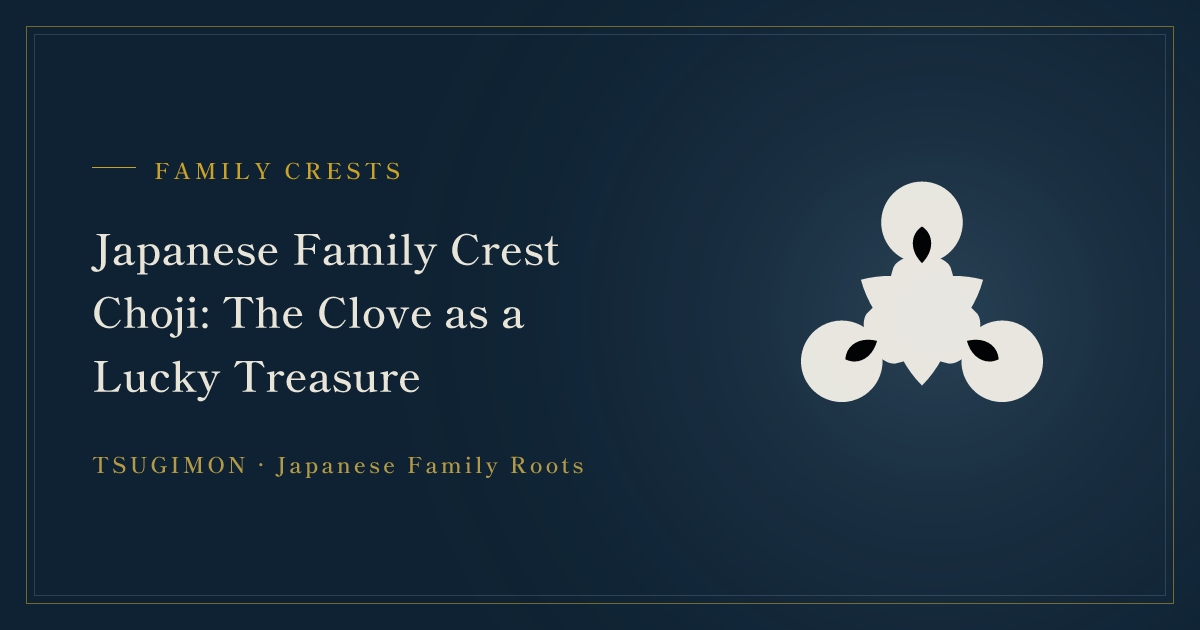
The choji-mon (丁子紋) is a Japanese family crest based on choji (丁子), the spice known in English as clove.
The name is said to come from the shape of the dried clove bud, which looks like the Japanese character 丁. It is a less common crest than some, but it has long been valued as a lucky design.
What is choji?
Choji is the dried flower bud of a tropical tree. It has a strong, sweet scent and has been used to flavor food, in medicine, and in incense.
The tree does not grow in Japan, so in earlier times cloves had to be carried from distant lands. That made them precious.
Cloves had many uses in Japanese life:
- Incense and scent sachets: the fragrance was enjoyed in incense blends and small cloth pouches called nioi-bukuro (匂い袋).
- Medicine: cloves are said to have been used as a warming remedy.
- Choji oil: choji-abura (丁子油), oil scented with clove, has long been used to protect Japanese swords from rust.
Sword-care oil is still often called choji oil today. The scent of clove may have been familiar to the samurai class, the hereditary warriors of premodern Japan, for that reason.
Why the clove became a crest
Choji is one of the takara-zukushi (宝尽くし), the "collection of treasures." This is a traditional pattern that gathers auspicious objects, such as a magic mallet and a sacred jewel, into one design. It has long decorated kimono, lacquerware, and ceramics.
The treasures pattern is still common today. You may see it on New Year decorations, on celebratory furoshiki wrapping cloths, or on children's kimono for festive occasions. Spotting the clove among those treasures is a nice way to connect the crest with everyday Japanese design.
Precious, fragrant, and counted among the treasures: for these reasons, the clove is thought to have become a pattern expressing wishes for prosperity and happiness.
In time it was also used as a family symbol. A kamon (家紋), the family crest, is a design passed down in a household, shown on gravestones, formal kimono, and heirlooms. Which families began using the clove, and when, differs from family to family.
Many crests show everyday things: plants, tools, landscapes. It is striking that a spice from faraway lands became a family emblem in Japan. It shows how highly cloves were prized. For an overview of how crests are grouped, see Japanese family crest types.
Types of clove crests
Clove crests vary by how many buds there are and how they are arranged:
- Hitotsu choji: a single clove bud, the basic form.
- Chigai choji: two clove buds crossed over each other.
- Choji-domoe (丁子巴): clove buds arranged in a swirling tomoe pattern. The tomoe is a comma-like swirl used in many crests.
- Maru ni versions: any of these inside a circle. "Maru" means circle, and adding one is a very common way to vary a crest.
The choji-domoe is especially eye-catching, with a sense of turning motion. Several buds curve in the same direction, like the blades of a pinwheel. If you want to know more about the swirl itself, see our article on the tomoe crest.
A clove bud is rounded at the top and narrows toward the base. If you see a crest made of small rod-like shapes with round heads, think of this shape.
Because the clove crest is less familiar, it is sometimes mistaken for other designs. A swirling choji-domoe can look at first like an ordinary tomoe, and a crossed pair of cloves can resemble other crossed designs, such as feathers or leaves. Look at the ends of each shape. Clove buds have a small rounded head, while feathers taper to a point and leaves have veins.
If you are working from an old photograph, try to find the clearest image you can, ideally of the back of a formal kimono, where the crest is largest. Zooming in on a scanned copy often reveals details that are hard to see in the original print. Writing down the possible names, such as "choji-domoe?", gives you something concrete to check later with a relative or a crest reference book.
Frequently asked questions
Is the clove crest rare?
Compared with crests used by very many families, such as paulownia, wisteria, or katabami (wood sorrel), you may see it less often. Still, there are several variations, and families in many regions have used it.
What kind of family uses a clove crest?
There is no single lineage tied to it. Crests were chosen family by family, so a crest alone cannot tell you your roots. Combine it with other clues, such as the koseki (戸籍), Japan's family registry — a government record that lists each household's members — and family graves.
I found a crest I cannot identify on an old family kimono. Could it be a clove?
It might be. Look for small rod shapes with a rounded head and a narrow base, sometimes crossed or swirling. Take a clear photo and compare it with crest references, or ask a relative in Japan who may know the family's crest name.
A small step for today
Take a close look at the crest on a family gravestone, household altar, or old kimono, and photograph it clearly. If you see small rod-like shapes with round heads, it may be a clove crest. You can compare the shape with crests listed by surname on our crest lookup by surname (in Japanese). It is in Japanese, but the images make it easy to compare.
Written by Tsucchi, TSUGIMON
The TSUGIMON family-tree reading is currently in Japanese. Your browser's translate feature works well with it, and it takes about three minutes. Free, no sign-up.