TSUGIMON
Igeta Crest Meaning: The Japanese Well-Frame Crest of the Ii Clan
Learn the igeta crest meaning, the Japanese family crest shaped like a wooden well frame, how it differs from izutsu, and the legend behind the Ii clan's crest.
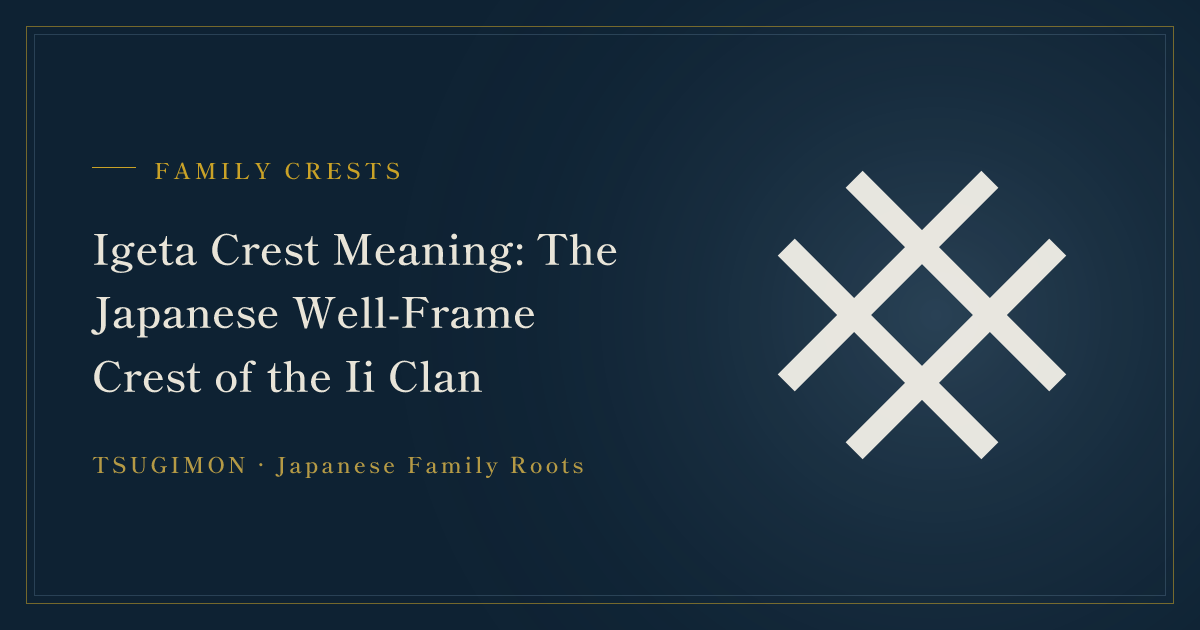
Have you ever seen a family crest that looks like the kanji 井 — a shape a bit like a hash sign?
It may be an igeta (井桁) crest or an izutsu (井筒) crest. Both are connected to wells.
In this article, we look at the difference between igeta and izutsu, and at a legend about a well told in the Ii family.
What are igeta and izutsu crests?
A kamon (家紋) is a family crest — a symbol a Japanese family uses on formal kimono, gravestones and belongings. For a broad overview, see our guide to Japanese family crest types.
Old wells in Japan were holes dug into the ground with a wooden frame built around the opening. The frame kept people and things from falling in.
This wooden frame is called an igeta or an izutsu. The igeta crest and the izutsu crest turn that shape into a design.
Water is essential to life. A well was an important place that supported the daily life of a household or a whole village. In many communities, people gathered at the shared well to draw water and talk. Japanese even has the phrase idobata kaigi (井戸端会議), a "well-side meeting," for casual neighborhood chatting.
It makes sense that the frame of a well became a symbol of a family.
The difference between igeta and izutsu
In the world of family crests, the two are usually told apart like this:
- Izutsu (井筒) — four pieces of wood set straight, forming a shape close to a square.
- Igeta (井桁) — the same construction set at a slant, forming a shape close to a diamond.
In everyday language, though, people sometimes call any well frame an "igeta." Crest names can also vary a little from one reference source to another.
Common forms
- Maru ni igeta (丸に井桁) — an igeta enclosed in a circle.
- Igeta ni tachibana (井桁に橘) — an igeta combined with tachibana, the blossom of a Japanese citrus tree.
- Kumi-izutsu (組み井筒) — two izutsu frames overlapping.
Whether the lines are thick or thin, and how the corners are drawn where the wood crosses, can also change the name.
The igeta of the Ii clan
The family best known for the igeta crest is the Ii clan. The Ii came from Iinoya, in Totomi Province (the western part of today's Shizuoka Prefecture). In the Edo period (1603–1868), they became the lords of the Hikone domain (in today's Hikone City, Shiga Prefecture). Ii Naomasa, who served Tokugawa Ieyasu, the founder of the Tokugawa shogunate, is especially famous. He is counted among the "Four Heavenly Kings" (shitenno, 四天王), the four generals most closely associated with Ieyasu.
The Ii family has a legend about its beginnings. It is said that the man regarded as the family's founder was found as a baby beside a well in Iinoya.
A family that began at a well took the well frame as its crest — that is how the story has been passed down. Besides the igeta, the Ii are also known to have used a tachibana crest.
Surnames and the igeta
Many Japanese surnames contain the kanji 井 (i), which means "well" — for example Inoue (井上), Iguchi (井口) and Ishii (石井). It is said that some of these families chose an igeta or izutsu crest because of the character in their name. You can read more about one of these names in our article on the Inoue surname meaning.
But this is only a tendency. Many families whose surname contains 井 do not use the igeta. And some families without 井 in their surname do use it.
Crests were chosen family by family. The best way to know your crest is to check within your own family.
Crests often remain on the family gravestone and its flower holders, on ihai (位牌) memorial tablets in the butsudan (仏壇), the household Buddhist altar, and on the back of formal mourning clothes or a mon-tsuki kimono — a formal kimono marked with the family crest. When you find one, take a photo from straight in front. If a relative's family crest looks slightly different, that may be a clue to where the family branched.
For readers outside Japan, check a grandparent's gravestone, keepsakes such as lacquered boxes or kimono, and old formal photos. Relatives in Japan may be able to look at the family grave for you.
Frequently asked questions
Are igeta and izutsu the same thing?
Both show a well frame, but in family crests they are usually distinguished by shape. The square-like one is generally called izutsu, and the diamond-like one is called igeta.
Does an igeta crest mean my family descends from the Ii clan?
Not necessarily. The igeta has been used by many families, some because of the character in their surname and some because they inherited the crest of a related household. To learn your family's history, look at family records and listen to what relatives remember.
My surname has the kanji 井. Is our crest an igeta?
It might be, but you cannot tell from the surname alone. Crests vary from family to family, even with the same surname. Check gravestones, kimono and photos, or ask relatives.
A small step for today
When you find your family crest on a gravestone or crested kimono, check whether the 井 shape is set straight or at a slant. That alone tells you whether it is likely an izutsu or an igeta. To see crests often found with your surname, try our tool to look up crests by surname (in Japanese).
Written by Tsucchi, TSUGIMON
The TSUGIMON family-tree reading is currently in Japanese. Your browser's translate feature works well with it, and it takes about three minutes. Free, no sign-up.