TSUGIMON
Hemp Leaf Crest Meaning: Asa-no-ha, a Pattern of Growth
Learn the hemp leaf crest meaning in Japan, why the asa-no-ha pattern was used on baby clothes, the forms of the crest, and how to find your own.
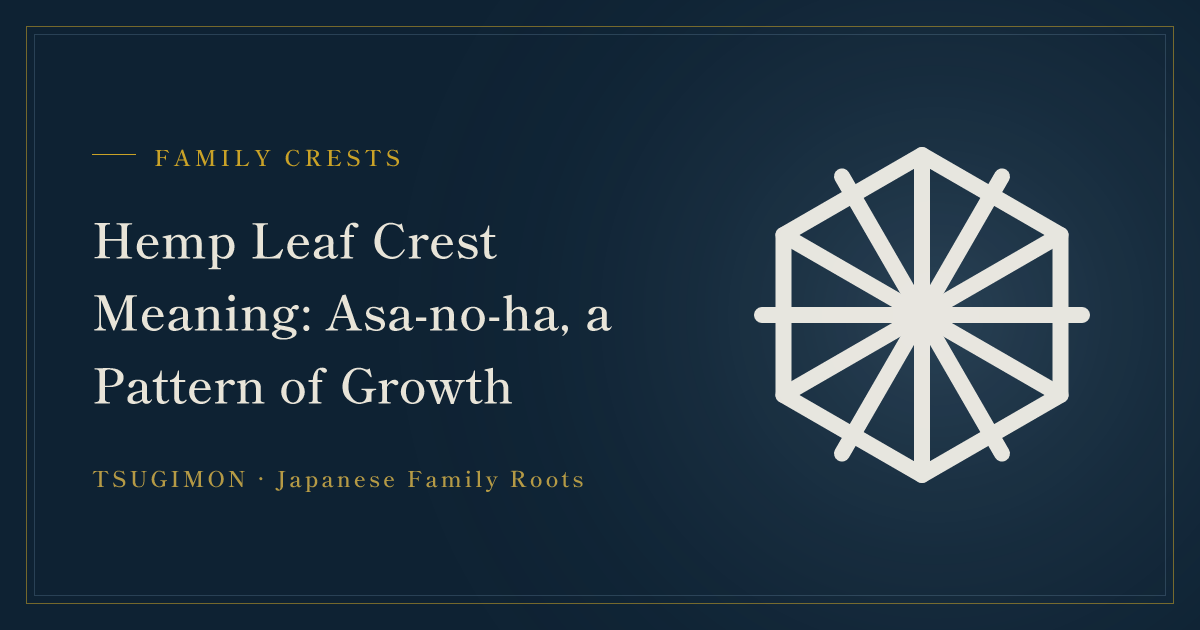
Six-pointed, star-like shapes linked together in an endless pattern. You may have seen it on kimono, fabric or tableware. This is asa-no-ha (麻の葉), the hemp leaf pattern.
The hemp leaf has been used not only as a pattern but also as a family crest. A crest based on the hemp leaf is called asa-no-ha-mon or asa-mon (麻紋).
In this article, we look at what the hemp leaf crest means and the wishes people have placed in it.
What is the hemp leaf crest?
A kamon (家紋) is a family crest — a symbol a Japanese family uses on formal kimono, gravestones and belongings. For a broad overview, see our guide to Japanese family crest types.
Asa (麻), hemp, was a familiar plant in Japanese life for a very long time. Fibers from its stems were made into thread, cloth and rope. It is said that before cotton became widespread, much of ordinary people's clothing was made from hemp.
The hemp leaf crest turns the shape of the hemp leaf into a design.
Common forms
- Asa-no-ha (麻の葉) — six leaves spreading out from the center.
- Maru ni asa-no-ha (丸に麻の葉) — the hemp leaf enclosed in a circle.
- Asa-no-ha-guruma (麻の葉車) — hemp leaves arranged in a circle like a wheel.
A real hemp leaf has long, narrow leaflets that spread out like the fingers of a hand. The crest arranges that image into a neat geometric shape — a regular shape made of lines and angles.
Because the shape is built from simple straight lines, it is easy to repeat and combine. That is one reason the hemp leaf appears in so many crafts in Japan, from dyed fabric to kumiko (組子), a traditional woodwork technique that fits small pieces of wood together into lattice patterns without nails.
What hemp means in Japan
Hemp grows very fast and very straight. Because of this, people have linked it to the wish that "a child may grow up healthy and straight."
On baby clothes
For this reason, the hemp leaf pattern has often been used on ubugi (産着), the kimono put on newborn babies.
The custom of choosing the hemp leaf pattern with the wish that a child grows up strong is still carried on today. Practices differ by region and family, but you may see it on kimono for omiyamairi (お宮参り), a baby's first shrine visit. Our article on the omiyamairi shrine visit for newborns explains that tradition.
A link to Shinto ritual
Hemp has also been used in sacred settings. In Shinto, the native religion of Japan, hemp is sometimes used in purification tools at shrines and in shimenawa, the sacred ropes that mark holy places.
Because of this, hemp also carries an image of purity — something that clears away impurity. Please understand this as tradition and feeling. Wearing the hemp leaf pattern does not guarantee any particular result.
The hemp leaf as a family crest
Families using the hemp leaf crest can be found in many parts of Japan. Their reasons for choosing it were probably varied: some may have grown hemp or made cloth, others may have liked the wish for healthy growth.
Hemp was grown in many regions and supported daily life as a material for cloth and rope. A plant that was familiar, useful and lucky may have felt like a natural choice for a family's symbol.
However, you cannot tell from a surname that a family uses the hemp leaf crest. Even with the same surname, crests differ from family to family. Look around you to check your own:
- On the family gravestone or the flower holders in front of it.
- On the butsudan (仏壇), the household Buddhist altar, or on ihai (位牌) memorial tablets.
- On the back of formal mourning clothes or a mon-tsuki kimono — a formal kimono marked with the family crest.
- By asking your parents, grandparents or other relatives.
For readers outside Japan, the hemp leaf may appear not only as a crest but also on baby kimono or fabric passed down in the family. Old family photos of a baby's first shrine visit can be a good place to look. When you find a crest or pattern, take a clear photo from straight in front so you can compare it with reference books later.
Frequently asked questions
What does the hemp leaf pattern mean?
Because hemp grows fast and straight, the pattern carries the wish that a child grows up healthy. That is why it has often been used on newborns' clothing.
Is the hemp leaf crest different from the hemp leaf pattern?
The hemp leaf pattern repeats the shape across fabric or tableware with no gaps. The hemp leaf crest gathers that shape into a single design used as a family's symbol. Both are based on the same shape.
Is it okay to use the hemp leaf pattern on clothes for my own baby?
Yes. The hemp leaf is a widely used decorative pattern, and many families in Japan choose it for babies' clothing. It is a gentle way to share the tradition and its wish for healthy growth.
A small step for today
If your family has an old baby kimono or a kimono from a first shrine visit, look at its pattern. If you see the hemp leaf, ask your relatives who chose it and what they hoped for. For tips on starting those conversations, read our guide to interviewing grandparents about family history.
Written by Tsucchi, TSUGIMON
The TSUGIMON family-tree reading is currently in Japanese. Your browser's translate feature works well with it, and it takes about three minutes. Free, no sign-up.