KAKEIZ
Hawk Feather Crest (Takanoha): Meaning, Types and Families
The hawk feather crest, or takanoha-mon, was loved by samurai as a sign of courage. Learn its meaning, main types, and the Kikuchi, Asano and Aso Shrine links.
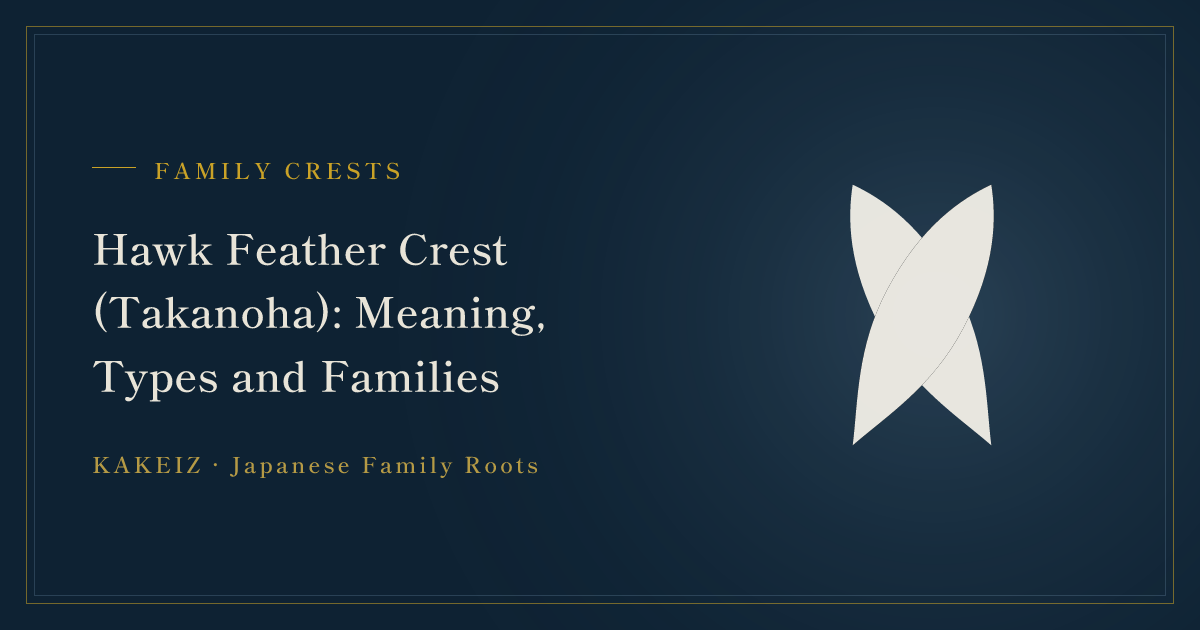
The takanoha-mon (鷹の羽紋), or hawk feather crest, shows the feathers of a hawk. The hawk is a strong, bold bird, and its feathers became a favorite crest of the samurai, the warrior class that ruled Japan for centuries. It stood for courage.
The best-known version, chigai-takanoha (違い鷹の羽), shows two crossed feathers. It is counted among the jūdai kamon (十大家紋), the "ten great crests" that are especially common across Japan. Kamon (家紋) is the Japanese word for family crest.
Where the hawk feather crest comes from
Hawks were prized by warriors from early times. Takagari (鷹狩り), falconry using trained hawks, was a pastime of people of high rank. Hawk feathers were also used as fletching, the feathers at the back of an arrow.
One of the oldest known images of a hawk feather crest appears in the Mōko Shūrai Ekotoba (蒙古襲来絵詞), a picture scroll about the Mongol invasions of Japan in 1274 and 1281. In it, the banner of Kikuchi Takefusa, a warrior from Higo (today's Kumamoto Prefecture in Kyushu), shows two feathers side by side.
There are also records suggesting that the Kikuchi family used hawk feathers even earlier, near the end of the Heian period in the 1100s.
Types of hawk feather crests
The name changes with how the feathers are arranged.
- Chigai-takanoha (違い鷹の羽) — two feathers crossed diagonally.
- Maru ni chigai-takanoha (丸に違い鷹の羽) — crossed feathers inside a circle. This is a very common family crest.
- Narabi-takanoha (並び鷹の羽) — two feathers standing side by side.
- Hitotsu-takanoha (一つ鷹の羽) — a single feather.
The feathers carry dark markings called fu (斑). The number and shape of these markings also separate one type from another. It is said there are more than 60 variations in all.
To identify one, first look at how many feathers there are and how they are placed. Crossed means chigai. Side by side means narabi. Then check for a surrounding circle.
A similar crest is the yabane (矢羽), the arrow-feather crest. It shows fletching, and often includes part of the arrow shaft at the base. The hawk feather crest shows the feather itself, so the shape of the shaft is a good clue for telling them apart. For a broader overview of crest families, see types of Japanese family crests.
Families and shrines that used the hawk feather
Aso Shrine
Aso Shrine in Kumamoto Prefecture uses the crossed hawk feathers as its shinmon (神紋), its shrine crest.
A story says that the Kikuchi family, who protected the shrine, began using hawk feathers after receiving the design for their curtain crest from Aso Shrine in a dream. Because of links like this, the hawk feather crest is said to be especially common in Kyushu, the southern main island of Japan.
The Asano family
The Asano family, lords of the Hiroshima domain, used the maru ni chigai-takanoha. A branch of the family included Asano Naganori, lord of Akō. In 1701 he attacked an official named Kira Kōzukenosuke inside Edo Castle. That incident led to the story of the forty-seven loyal retainers, known in Japan as Chūshingura (忠臣蔵) and retold in countless plays and films. Because of this, the crest often appears in Chūshingura plays and pictures.
Other families
It is said that around 120 daimyō (feudal lords) and hatamoto (direct retainers of the shogun) families used the hawk feather during the Edo period (1603–1868). Known examples include the Abe family of the Bingo-Fukuyama domain and the Kuze family of the Shimōsa-Sekiyado domain. It is also said to be common in Kyoto and Tokyo, which were centers of warrior government. You can read more about warlords and their crests in samurai family crests of the Sengoku period.
Even among the same crossed feathers, each family drew the markings a little differently. Some versions carry family names, such as "Asano takanoha" and "Inoue takanoha."
Checking the feathers on your family crest
Because the hawk feather is one of the most common crests in Japan, there is a fair chance you will meet it in your own family's belongings. If your family is of Japanese descent, look for the crest on a grandparent's gravestone, a formal kimono with small crests, or a butsudan, the household Buddhist altar. Old studio portraits are worth a look too, since crests on formal kimono often show on the chest and sleeves. With the crossed feathers, pay attention to which feather is on top, the right or the left. That small detail differs from family to family, and it is easy to miss in a quick sketch. A sharp photo saves the details, including the markings on each feather. If you can, share it with relatives in Japan and ask what they know.
Frequently asked questions
If our crest is a hawk feather, was our family samurai?
Not necessarily. The hawk feather spread to many families from the Edo period onward. A crest alone cannot tell you your ancestors' social status.
Is there a rule about which feather goes on top?
Whether the right or left feather is on top differs by family. When you check your own crest, look closely at which one overlaps the other.
What is the difference between crossed and side-by-side hawk feathers?
Chigai-takanoha has two feathers crossed diagonally. Narabi-takanoha has two feathers standing parallel. After that, check for a circle and the way the markings are drawn to narrow it down further.
A small step for today
The next time you see your family's grave or an old kimono with a crest, take a close look at the feathers. Is the right one on top, or the left? That tiny difference is a real clue. If you are wondering whether your ancestors were warriors at all, read were my ancestors samurai?
Written by Tsucchi, KAKEIZ
The KAKEIZ family-tree reading is currently in Japanese. Your browser's translate feature works well with it, and it takes about three minutes. Free, no sign-up.