TSUGIMON
Gyoyo Crest Meaning: A Japanese Crest From a Horse Ornament
Learn the gyoyo crest meaning, a Japanese family crest born from an ancient horse ornament, its link to the Nabeshima and Otomo clans, and how to find your own.
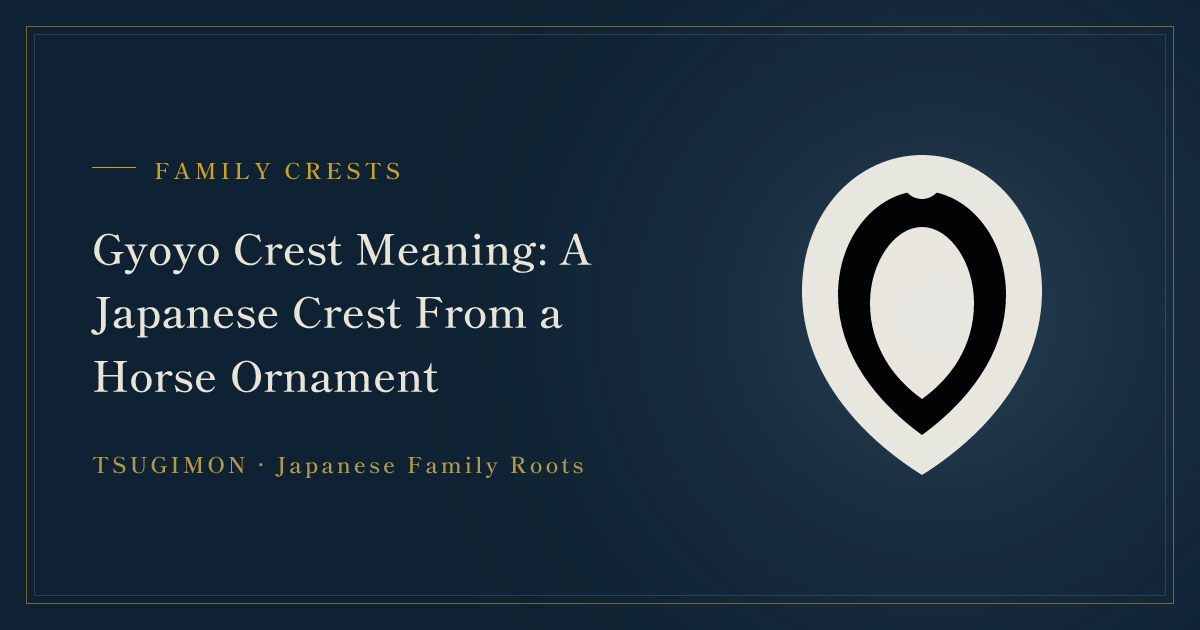
The kanji 杏葉 are read "gyoyo." Even many people in Japan hesitate when they first see this crest name.
The gyoyo crest shows two leaf-like shapes facing each other from the left and right. It has a calm, balanced look. It is best known for its connection to powerful daimyo families on the island of Kyushu, in southwestern Japan.
In this article, we look at what the gyoyo crest is, where the name comes from, and which families are linked to it. If you have spotted this design on a family heirloom or a grandparent's gravestone, this is a good place to start.
What is a gyoyo crest?
A kamon (家紋), or family crest, is a symbol a Japanese family uses to mark itself. Crests appear on formal kimono, gravestones, household altars and old belongings. If crests are new to you, our guide to Japanese family crest types gives a helpful overview.
The gyoyo began not as a crest but as a decoration for horses. It was part of bagu (馬具), horse gear — the equipment used for riding a horse or loading it with goods.
A gyoyo was an ornament that hung from the straps around a horse's chest and hindquarters. Ornaments called gyoyo have been found among horse gear excavated from kofun (古墳), the large burial mounds built for powerful people in ancient Japan. So this is a very old shape.
The first kanji, 杏, means apricot. It is said that the ornament got its name because its outline looked like an apricot leaf.
Over time, the shape of this ornament came to be used as a design in its own right, and it eventually became a family crest.
Common forms of the gyoyo crest
There are several versions you may come across:
- Daki-gyoyo (抱き杏葉) — two gyoyo shapes "embracing" each other from left and right. This is the most common form.
- Hana-gyoyo (花杏葉) — a version with flowers placed inside or between the gyoyo shapes.
- Maru ni daki-gyoyo (丸に抱き杏葉) — the daki-gyoyo surrounded by a circle.
The differences can be very small. The way the leaf veins are drawn, or whether a flower sits on top, can change the crest's name. That is why careful photos matter when you try to identify one.
The gyoyo crests of the Nabeshima and Otomo clans
Two families are especially well known for the gyoyo crest: the Otomo clan of Bungo Province (today's Oita Prefecture) and the Nabeshima clan of Hizen Province (today's Saga Prefecture).
The Otomo were a daimyo family — a regional warlord house — that held great power in northern Kyushu during the Sengoku, or Warring States, period (roughly the late 1400s to the late 1500s). They used the gyoyo as their family crest.
The Nabeshima later became the ruling lords of the Saga domain during the Edo period (1603–1868). Their version is sometimes called "Nabeshima gyoyo."
There is a story about how the Nabeshima came to use the gyoyo. At the Battle of Imayama, the Ryuzoji clan defeated an Otomo army. Nabeshima Naoshige, a leading retainer of the Ryuzoji, distinguished himself in the fighting, and it is said that he then adopted the Otomo's gyoyo as his own crest.
The winning side taking on the crest of the losing side tells us something important. Family crests were not only decorations. They could also carry a family's history. For more on crests from this era, see our article on samurai family crests of the Sengoku warlords.
Does a gyoyo crest mean descent from a daimyo?
Not necessarily. Not every family with a gyoyo crest descends from the Otomo or the Nabeshima.
Crests spread in many ways. Retainers sometimes received a crest from the family they served. Other families borrowed the crest of a household they were connected to. Popular crests also differed from region to region. Even when two families share the gyoyo crest, it is best to assume that each family has its own story.
How to check your own family crest
If you think your family's crest might be a gyoyo, try looking for it in these places:
- On the family gravestone or the flower holders in front of it.
- On the butsudan (仏壇), the household Buddhist altar, on ihai (位牌) memorial tablets, or on items used for memorial services.
- On the back of formal mourning clothes or a mon-tsuki kimono — a formal kimono decorated with the family crest.
- By asking your parents, grandparents or other relatives.
For readers outside Japan, crests sometimes travel in quiet ways. A crest may be carved on a grandparent's gravestone abroad, stitched onto a kimono kept in a trunk, or visible in an old wedding photo. If you have relatives in Japan, they may be able to look at the family grave or altar for you.
When you find a crest, take a clear photo from straight in front. Small details — whether there is a circle around it, whether there is a flower — are the clues that help you identify it later.
Frequently asked questions
How do you pronounce the gyoyo crest?
It is pronounced "gyo-yo," and the crest is called gyoyo-mon in Japanese. The first kanji means apricot. It is said that the name comes from the horse ornament's resemblance to an apricot leaf.
Is a family with a gyoyo crest originally from Kyushu?
The crest has strong ties to daimyo families in Kyushu, but not every family with a gyoyo crest comes from there. Crests spread to retainers and related families, and many families moved over the generations. To learn your own family's history, look at family records and listen to what relatives remember.
My family emigrated generations ago. Can I still find our crest?
Often, yes. Crests survive on gravestones, kimono, lacquerware and photos, even far from Japan. If nothing has survived abroad, relatives in Japan may know the crest from the family grave.
A small step for today
Look for your family crest on a gravestone, kimono or old photo. If it turns out to be a gyoyo, compare the leaf shapes and check whether a flower appears in the design. To see which crests are commonly found with your surname, try our tool to look up crests by surname (in Japanese).
Written by Tsucchi, TSUGIMON
The TSUGIMON family-tree reading is currently in Japanese. Your browser's translate feature works well with it, and it takes about three minutes. Free, no sign-up.