KAKEIZ
Chrysanthemum Crest: Japan's Imperial Kiku Mon and Its History
The chrysanthemum crest of Japan explained: how the imperial 16-petal kiku mon began, the Meiji-era rules that limited its use, and other forms you may see.
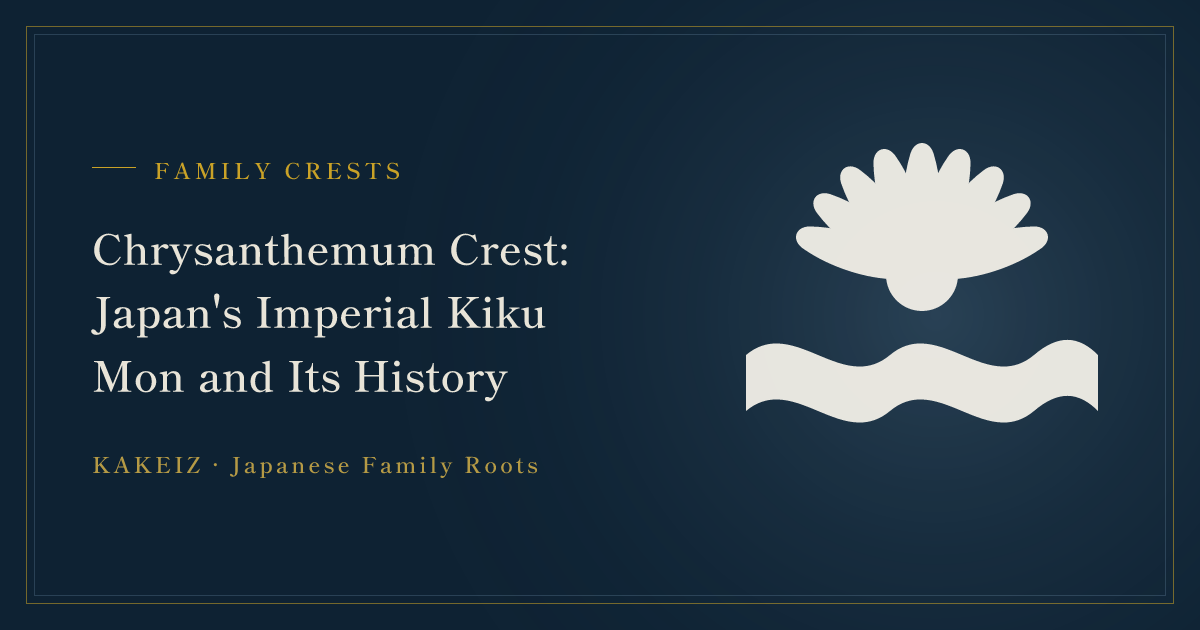
The kikumon (菊紋), or chrysanthemum crest, is a crest based on the chrysanthemum flower. The best-known version is the juroku-yae-omotegiku (十六八重表菊), a chrysanthemum with sixteen petals in a double layer, seen from the front. It is known as the crest of Japan's imperial family.
A Japanese family crest is called kamon (家紋). Most crests belong to ordinary families, but the chrysanthemum has a special place. In the Meiji era (1868–1912), there was even a rule that no one outside the imperial family could use it. Let's look at why it came to be treasured so highly.
Where the chrysanthemum crest began
The chrysanthemum originally came to Japan from China. It was believed to have the power of long life, and nobles of the Nara and Heian periods (710–1185) loved it.
It is said that the flower became an imperial emblem through Retired Emperor Go-Toba (1180–1239), who lived in the Kamakura period. He loved chrysanthemums and put chrysanthemum patterns on his personal belongings. Later emperors continued the custom, and over time the sixteen-petal double chrysanthemum became established as the imperial crest.
Go-Toba also loved swordmaking. It is said that he took part in making swords himself and had a chrysanthemum carved on them. These swords are called kiku-gosaku (菊御作), and some survive today.
At that time, though, the chrysanthemum was not yet a crest reserved for the imperial family. Court nobles, temples and shrines also used it, and the rules were loose. That changed greatly in the Meiji era.
How its use came to be limited
In the Meiji era, the chrysanthemum became a crest that people could not use freely. Here is the main course of events:
- 1868 … A government decree banned the careless use of the chrysanthemum crest on things like paper lanterns and pottery.
- 1869 … Temples and shrines, with some exceptions, were also banned from using the chrysanthemum crest.
- 1871 … It was decided that no one outside the imperial family could use the chrysanthemum crest. The crest for other members of the imperial family was set as the juyon-hitoe-uragiku (十四一重裏菊), a fourteen-petal single chrysanthemum seen from the back.
- 1926 … An imperial household regulation set the sixteen-petal double chrysanthemum as the emperor's crest, and the fourteen-petal single version for princes and other members of the imperial family.
After World War II, these rules were abolished. Today no law officially names the chrysanthemum as the imperial crest. Even so, by custom it continues to be used as the imperial family's emblem.
Also, designs that closely resemble the sixteen-petal double chrysanthemum cannot be registered as trademarks in Japan. They are treated as similar to a national emblem.
Types of chrysanthemum crest and where you see them
There are several chrysanthemum designs:
- Juroku-yae-omotegiku … Sixteen petals in two layers. The imperial crest.
- Juyon-hitoe-uragiku … Fourteen petals seen from the back. The crest of other imperial family members.
- Juroku-hitoe-omotegiku (十六一重表菊) … Sixteen petals in a single layer. Used on the cover of the Japanese passport.
- Kikusui (菊水) … Half a chrysanthemum floating on flowing water.
Kikusui is famous as the crest of Kusunoki Masashige (died 1336), a warrior of the Nanboku-cho period, the time when two rival imperial courts existed. The shrine dedicated to him in Kobe also uses kikusui as its crest.
What about shrines in general? Even after the Meiji bans, some shrines with close ties to the imperial family received permission to keep using the chrysanthemum. That is why you can still see chrysanthemum crests on the buildings and curtains of some shrines today.
For families outside Japan, a chrysanthemum on a grandparent's gravestone or kimono can be exciting to find. But many family crests include chrysanthemum shapes that are quite different from the imperial crest. Count the petals and look at the shape before drawing conclusions. Is the flower seen from the front or the back? Is it single or double? Is it a whole flower or only half, as in kikusui? Note whether it sits inside a ring or is combined with leaves or water. A clear photo of these details is the most useful record you can keep, and it makes it easier for relatives or crest references to identify the design. Our guide to Japanese family crest types shows how crests are grouped by motif.
Frequently asked questions
If our family crest is a chrysanthemum, are we related to the imperial family?
Not necessarily. Many family crests use chrysanthemum shapes, and they differ from the imperial sixteen-petal double chrysanthemum. A crest alone cannot prove a family's history.
Can I use a chrysanthemum crest today?
Families who have inherited a chrysanthemum crest use it as usual. However, avoid using designs that could be confused with the imperial crest as a shop logo or brand mark. Such designs cannot be registered as trademarks.
Is the chrysanthemum on the passport the same as the imperial crest?
No. The Japanese passport shows the sixteen-petal single chrysanthemum. The imperial crest is the sixteen-petal double chrysanthemum, with two layers of petals. If you look closely, you can see the difference.
A small step for today
If you have a Japanese passport, or a relative does, look at the cover and count the chrysanthemum petals. It brings the crest's history a little closer. Every family crest has a story of its own. If you are curious about yours, you can look up crests by surname on our crest page. The page is in Japanese, but the crest images are easy to browse.
Written by Tsucchi, KAKEIZ
The KAKEIZ family-tree reading is currently in Japanese. Your browser's translate feature works well with it, and it takes about three minutes. Free, no sign-up.