KAKEIZ
Cherry Blossom Crest (Sakura-mon): Meaning, Types and History
The cherry blossom crest, or sakura-mon, is rare among samurai families despite the flower's fame. Learn its meaning, main types, and the shrines that use it.
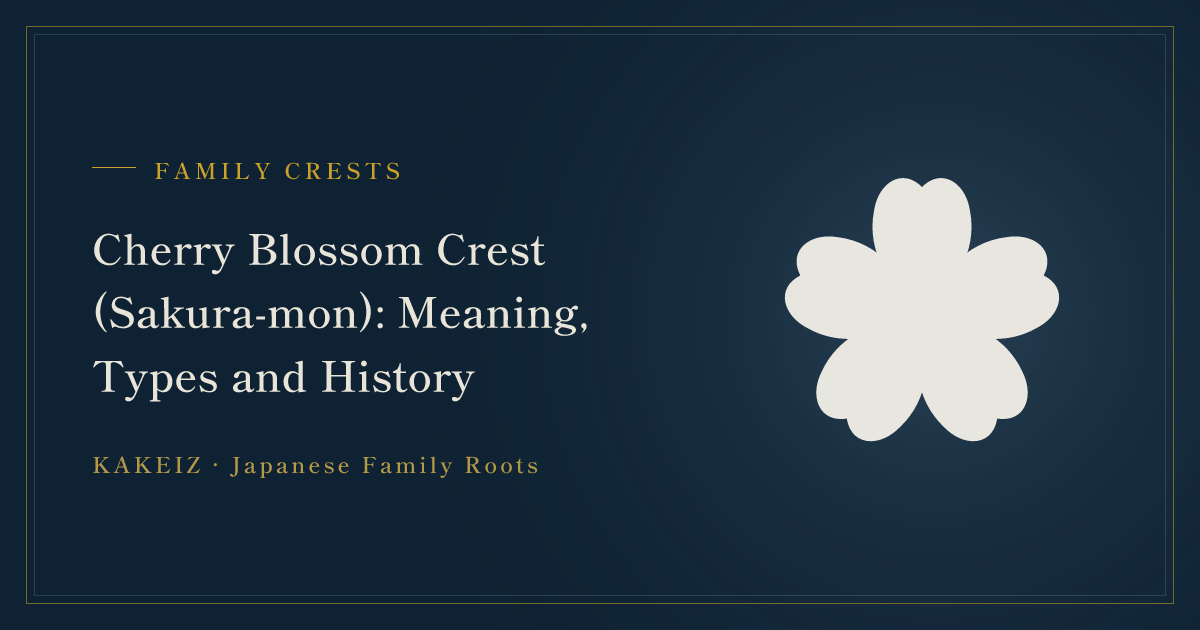
The sakura-mon (桜紋), or cherry blossom crest, shows the flower of the cherry tree. Cherry blossoms are perhaps the most famous symbol of Japan. Yet, surprisingly, the cherry blossom is not a common crest among samurai families, the warrior households that ruled Japan for centuries.
One theory says this is because the blossoms fall so quickly. Even so, the cherry blossom crest is still treasured today as the crest of several shrines. In Japanese, a family crest is called a kamon (家紋).
Where the cherry blossom crest comes from
The cherry blossom has been loved in Japan since ancient times. In the Man'yōshū (万葉集), a poetry collection compiled in the 700s, there are more poems about plum blossoms than cherry. But by the Heian period (794–1185), it is said that the word hana, "flower," on its own had come to mean the cherry blossom.
The blossoming of the cherry was also seen as a sign that the season for planting rice had come. The flower is sometimes linked with Konohana-no-Sakuya-hime (木花咲耶姫), a goddess associated with Mount Fuji.
As a design, the cherry blossom was used on clothing and household goods from the Heian period, and later it also became a family crest.
The basic crest has five petals. The small notch at the tip of each petal is the mark of a cherry blossom. Some versions show the stamens in the center, and some do not.
In classical poetry, simply saying "flower" was enough to mean cherry blossom, so central had it become to the season. Wearing it as a family emblem may have meant carrying the brightness and joy of spring.
Why is the cherry blossom rare among samurai crests?
Not many daimyō, the feudal lords of the Edo period (1603–1868), used a cherry blossom crest. No one knows the reason for sure, but a common explanation goes like this.
- Cherry blossoms bloom all at once and then scatter quickly.
- That fleeting quality may not have appealed to warrior families who hoped their house would last for generations.
This is only one theory, though. Some warrior families did use the cherry blossom.
The Hosokawa cherry
The Hosokawa family of Higo (today's Kumamoto Prefecture) is best known for its kuyō (九曜) crest, a design of nine circles representing stars and planets. But the family also used a cherry blossom crest, known as Hosokawa-zakura (細川桜). It is said to be one of the crests used by Hosokawa Tadaoki, a warlord of the late 1500s and early 1600s.
Families whose surnames contain the character for cherry, such as Sakurai and Sakurada, sometimes used a cherry blossom crest, choosing a crest that matched their name. You can learn more about this kind of link in Japanese family crest and surname.
The cherry blossom was also used by families who served at shrines. Even if it was rare among warriors, it was quietly handed down among people who held the flower dear.
In the Edo period, cherry blossoms became a much-loved pattern on kimono and everyday goods among townspeople. Both the crest and the pattern reflect how deeply people in Japan feel about this flower.
Types of cherry blossom crests, and shrines that use them
There are many cherry blossom designs. Here are some typical ones.
- Yamazakura (山桜), mountain cherry — a blossom with leaves behind it.
- Yaezakura (八重桜), double cherry — a blossom with layered petals.
- Urazakura (裏桜), reverse cherry — the blossom seen from behind.
- Hosokawa-zakura (細川桜) — the cherry used by the Hosokawa family, a typical example of a crest named after a family.
Some shrines use a cherry blossom as their shinmon (神紋), or shrine crest.
- Hirano Shrine in Kyoto, well known for its cherry trees, uses a cherry blossom crest.
- Ikuta Shrine in Kobe uses a double cherry crest.
- Sengen shrines, which honor Konohana-no-Sakuya-hime, are said to often use cherry blossom crests.
Finding a cherry blossom in your family's belongings
If your family is of Japanese descent, you might find a cherry blossom crest on an old formal kimono, a gravestone, lacquerware, or a butsudan, the household Buddhist altar. Look at the petal tips first. A notch means cherry. Then check for leaves, layered petals, or a circle around it.
Many families have heirlooms with cherry blossom patterns simply as decoration, which is different from a family crest. A crest is usually small, placed inside a circle or on its own, and repeated in fixed spots, such as on the back and sleeves of a formal kimono. If you are unsure, take a photo and ask relatives in Japan.
Frequently asked questions
Is a cherry blossom crest unlucky?
Not at all. The idea that warriors avoided it because it scatters is just one theory. It is not about the crest being good or bad. The cherry blossom has long been a symbol of joy and spring.
How can I tell a cherry crest from a plum crest?
Look at the petal tips. A small notch at the tip means cherry. Rounded tips mean plum.
Is a cherry pattern on a kimono the same as a family crest?
Not always. Cherry blossoms are a very common decorative pattern. A family crest is usually a small, set design placed in fixed positions, such as the back, chest and sleeves of a formal kimono.
A small step for today
Even outside spring, the cherry blossom crest is never far away. Look at shrine lanterns, old kimono, or the patterns on dishes. If you spot a notch at the tip of the petals, it is a cherry blossom. To explore other crests your family might have, try the crest lookup by surname (in Japanese).
Written by Tsucchi, KAKEIZ
The KAKEIZ family-tree reading is currently in Japanese. Your browser's translate feature works well with it, and it takes about three minutes. Free, no sign-up.