KAKEIZ
Japanese Family Crest and Surname: Why the Same Name Differs
Is a Japanese family crest tied to your surname? Families with the same name often use different crests. Learn why, the common patterns, and how to check yours.
Many people assume that every family named Sato has one crest, and every family named Suzuki has another. It is an easy assumption to make.
In fact, families with the same surname often use different crests. The Sato family next door and your own Sato family may have completely different designs. That is perfectly normal.
At the same time, crests and surnames are not totally unrelated. Some surnames do tend to go with certain crests. This article looks at both sides.
Surnames and crests began separately
The first thing to know is that the surname and the crest did not start out as a matched pair.
- Myoji (名字), the surname … The name a family used, often taken from the place they lived, their work, or the land around them.
- Kamon (家紋), the family crest … An emblem a family put on its clothing, belongings and graves as its mark.
Many surnames came from place names. Crests were chosen in other ways. A family might pick a design it liked, or receive one from a lord it served.
Also, many ordinary families in Japan only took official surnames fairly late. In 1875, during the Meiji era (1868–1912), the government required every commoner to register a surname. Some families made official a name they had used privately, and others chose a name at that time. Their crests, meanwhile, may already have been in use for generations.
Because of all this, two families with the same surname often turn out to have completely separate roots. For example, it is said that the Takahashi surname has several distinct lines in different regions, such as Yamato (today's Nara Prefecture) and Mikawa (today's eastern Aichi Prefecture).
Different roots, different crests. This is the main reason the same surname can have many crests.
Still, some crests are common for some names
Even so, certain surnames show certain patterns. Here are a few examples that are often mentioned:
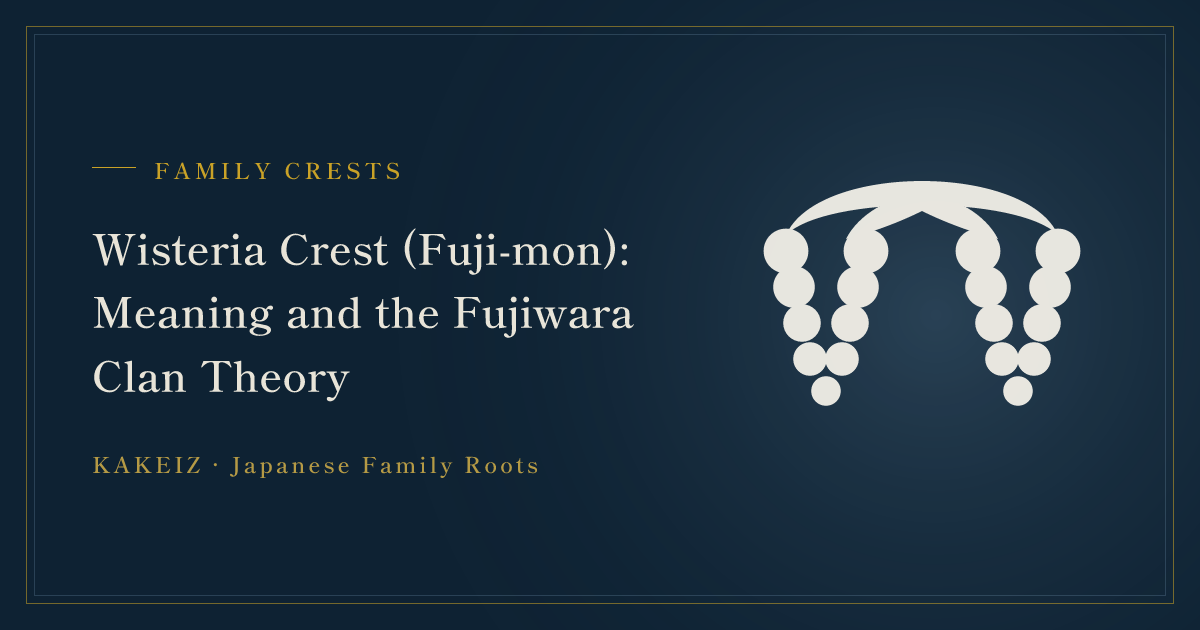
- Sato … Wisteria crests are said to be common, as are crests showing an ox-cart wheel, known as Genji-guruma (源氏車).
- Suzuki … Rice crests are said to be common, such as daki-ine (抱き稲), two curved stalks of rice.
- Takahashi … Crests showing a traditional hat, known as kasa (笠), are well known.
Why do these patterns appear?
Sato is a surname that, according to one theory, comes from the line of the Fujiwara, a powerful noble clan of old Japan. Wisteria, or fuji (藤), is the flower linked to the Fujiwara name. That may be why many Sato families use a wisteria crest.
For Suzuki, one theory says the name comes from susuki, a word for stacks of harvested rice. With such a close tie to rice, a rice crest may have been a natural choice.
In other words, the story behind a surname and the image in a crest are sometimes loosely connected.
Patterns are only a rough guide
It is important to remember that these are only tendencies.
Many Sato families do not use wisteria. Many Suzuki families do not use rice. Crests were also sometimes changed slightly when a branch family split off, and they could change through adoption or when a man married into his wife's family, a custom that was common in Japan. Popular crests also differ from region to region.
You can make a guess about your crest from your surname. But the only way to know your crest is to check it in your own family.
How to confirm your own crest
Crests often survive in more places than people expect.
- Look at the family gravestone and the flower holders beside it.
- Look at the butsudan (仏壇), the Buddhist family altar, and the memorial tablets and tools used for services.
- Look at the back of a mourning kimono or another formal kimono with crests.
- Ask your parents, grandparents and other relatives.
For families outside Japan, old photos can help too. Look for white crests on black formal kimono in wedding and funeral pictures. Some emigrant families also had a crest carved on gravestones abroad.
When you find a crest, take a photo. A crest's name can change with tiny details. Whether there is a ring around it, or whether the lines are thick or thin, will help you later. Our article on how to find your Japanese family crest covers more places to look.
If your crest turns out to be different from a relative's, that is a valuable discovery. It may show where the family branched, or where someone married in. It is a doorway into your family's history.
Frequently asked questions
If we have the same surname, do we have the same crest?
Not necessarily. Surnames and crests began separately, and families with the same name often have different roots. Some names have common crests, but you should confirm your own on a grave or a kimono.
Is it strange that our crest differs from a relative's?
No. Crests were sometimes changed slightly when a family branched off, and they could change through adoption or marriage. A difference is a clue about where the family split, so it is worth photographing both.
Can I find my crest from my surname alone?
You can get a starting guess, but not an answer. A surname can point to crests that are common for that name. Only your family's own records, graves or heirlooms can tell you which crest your family actually used.
A small step for today
First, see which crests are common for your surname. Then compare them with what you find on a family grave or kimono. If yours is different, that may be the start of your family's own story. You can look up crests by surname on our crest page. The page is in Japanese, but the crest images are easy to compare.
Written by Tsucchi, KAKEIZ
The KAKEIZ family-tree reading is currently in Japanese. Your browser's translate feature works well with it, and it takes about three minutes. Free, no sign-up.