TSUGIMON
Japanese Family Crest Butterfly: Ageha-cho and the Taira Legend
The butterfly Japanese family crest explained: the ageha-cho swallowtail, its link with the Taira (Heike) clan, Oda Nobunaga, the Ikeda family, and variations.
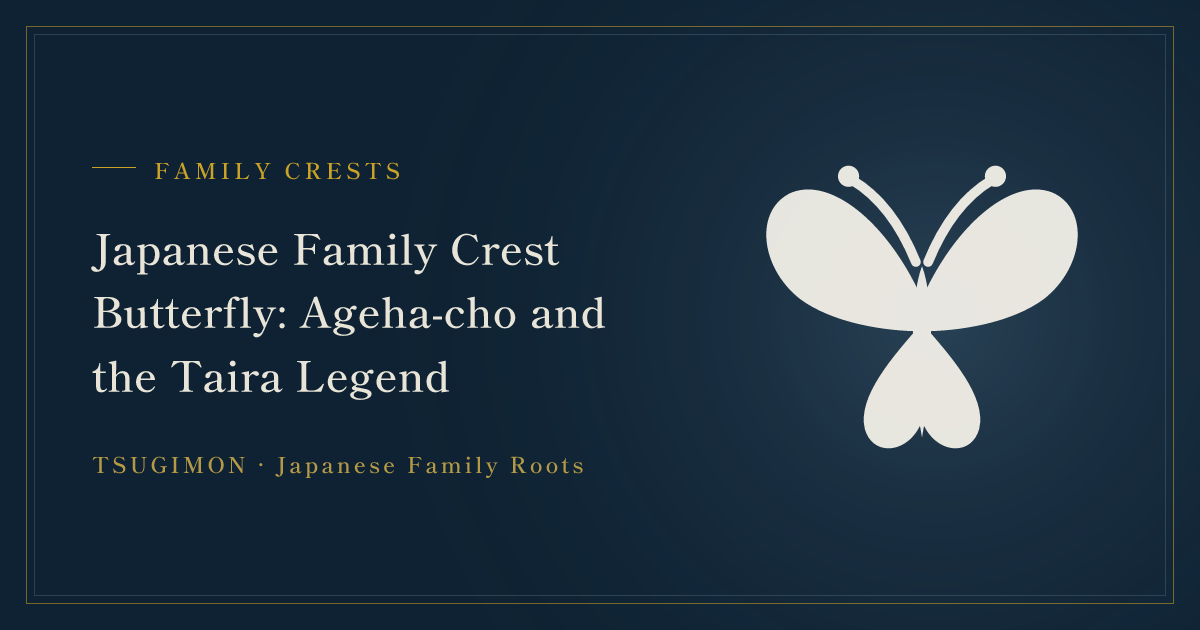
The cho-mon (蝶紋) is a Japanese family crest shaped like a butterfly. The best known version is the ageha-cho (揚羽蝶), a swallowtail butterfly drawn from the side with its wings spread wide.
The swallowtail is often called "the crest of the Heike," the Taira clan of medieval Japan. That idea is widespread, but it deserves a closer look.
What is the butterfly crest?
Cho-mon is the general name for crests based on butterflies. There are many forms: butterflies with open wings, pairs facing each other, and rounded, pattern-like versions.
People have suggested several reasons why butterflies were valued:
- A caterpillar becomes a chrysalis and then a butterfly, so some see it as a symbol of rebirth or renewal.
- Its graceful shape made it a favorite pattern on the clothing and furnishings of nobles and warriors.
Butterfly patterns decorated kimono and household objects even before family crests became common. Over time, the pattern also became a family symbol.
A kamon (家紋), the family crest, is a design passed down in a household and shown on gravestones, formal kimono, and heirlooms. For an overview of the many kinds, see Japanese family crest types.
The link with the Taira clan
The swallowtail is often described as the crest of the Kanmu Heishi (桓武平氏), the Taira clan founded by descendants of Emperor Kanmu who were given the family name Taira. In the 12th century, the Taira, also called the Heike, rose to great power at court before their defeat by the Minamoto in 1185.
However, it is not clear that Taira no Kiyomori and his family used a fixed family crest the way later families did. One view is that the image of "the Heike swallowtail" spread in later centuries.
What is well known is that many warrior families who claimed Taira descent used butterfly crests. The phrase "a crest linked to the Taira" grew out of that background. In the Sengoku and Edo periods, some families also shaped their genealogies and symbols to show descent from a famous lineage, and this may be part of why butterfly crests spread.
If you want to learn more about the two great warrior clans, see our article on Minamoto and Taira descendants.
Families that used the swallowtail
Oda Nobunaga. Oda Nobunaga, the Sengoku-period warlord who began the unification of Japan, claimed Taira descent. His family's best-known crest is the Oda mokko, a melon-like design, but he is also known to have used the swallowtail butterfly.
The Ikeda family. The Ikeda family, who ruled the Okayama and Tottori domains in the Edo period (1603–1868), is also known for butterfly crests. The Ikeda butterfly is sometimes called the Bizen-cho, after Bizen, the old province around Okayama.
Many other families used butterfly crests too, especially those who claimed Taira roots.
The Taira also left a deep mark on Japanese storytelling. The Tale of the Heike, a medieval war epic, tells of their rise and their fall at the sea battle of Dan-no-ura in 1185. Its opening lines about the impermanence of all things are among the most famous in Japanese literature. Legends of Heike survivors hiding in remote mountain villages are told in many parts of Japan. Some families in those areas have traditions that they descend from Taira refugees, and a butterfly crest is sometimes part of that story. These are local traditions, and they are valued as such, but they are hard to prove with records.
For a family researcher, the lesson is simple. A butterfly crest can be a meaningful clue, especially when it matches a family tradition. But it becomes evidence only when written records, such as temple registers or the koseki (戸籍), Japan's family registry — a government record that lists each household's members — support the same story.
Types of butterfly crests
- Ageha-cho: the swallowtail with spread wings, seen from the side. This is the most familiar form.
- Maru ni ageha-cho: the swallowtail inside a circle. "Maru" means circle.
- Mukai-cho: two butterflies facing each other.
- Fusen-cho: a butterfly arranged into a round, ornamental shape.
Even within the swallowtail, the wing patterns and antennae differ from family to family. If your crest is a butterfly, compare the small details.
Butterfly crests can be tricky to read on weathered stone. The long antennae and the curling tails of the lower wings are often the first parts to wear away. If you can, photograph the crest in soft, low-angle light, such as early morning or late afternoon, when shadows bring out the carving. A rubbing on paper is another traditional method, but ask permission from the family or cemetery first, since it can damage fragile stone.
Frequently asked questions
Does a butterfly crest mean my family descends from the Taira?
Not necessarily. Butterfly crests are common among families that claimed Taira descent, but crests were chosen family by family. A crest alone cannot prove a family connection.
Did Taira no Kiyomori use the swallowtail?
It is not certain. Whether fixed family crests existed in Kiyomori's day is unclear, and one view is that the "Heike swallowtail" image spread later.
My grandparent's gravestone abroad has a butterfly on it. Is that a family crest?
It may well be. Families who emigrated often had their crest carved on gravestones. Take a clear photo from the front and compare it with known crests. A relative in Japan may also recognize it from the family grave or altar there.
A small step for today
Search a family gravestone, household altar, or old kimono for a butterfly crest. If you find one, note whether there is one butterfly or two, and whether it sits inside a ring. For tips on where crests usually appear, read how to find your Japanese family crest.
Written by Tsucchi, TSUGIMON
The TSUGIMON family-tree reading is currently in Japanese. Your browser's translate feature works well with it, and it takes about three minutes. Free, no sign-up.