TSUGIMON
Japanese Family Crest Kikyo: The Bellflower of Akechi Mitsuhide
The kikyo bellflower Japanese family crest explained: its five-petal shape, Akechi Mitsuhide's light-blue bellflower, the Toki clan, and common variations.
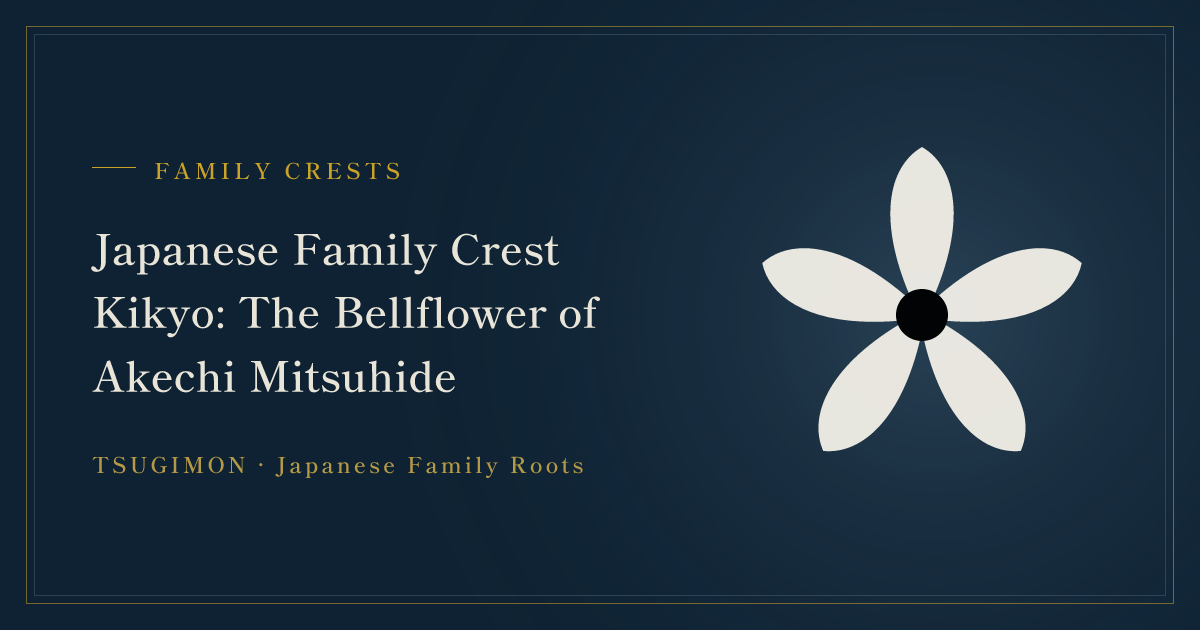
The kikyo-mon (桔梗紋) is a Japanese family crest shaped like the kikyo, the Japanese bellflower. Its five petals open like a star, giving it a clean, balanced look.
It is best known as the crest of Akechi Mitsuhide (明智光秀), the Sengoku-period general who turned against his lord Oda Nobunaga in 1582. But many other families used it too, and finding a bellflower on your family's gravestone does not link you to any one famous name.
What is the kikyo crest?
The kikyo is one of the "seven flowers of autumn" in Japanese tradition. Its blue-violet blossoms appear from late summer into autumn.
The crest shows the flower seen from directly above. Five equal petals form a neat shape close to a regular pentagon.
There are traditions about why warriors liked it:
- One theory is that the character 桔 contains 吉, the character for "good fortune," so the flower was seen as lucky.
- Another says the name was playfully read as "sara ni kichi" (更に吉), "even more good fortune."
These are traditions rather than proven history. A more practical reason may be that the shape is simple and easy to recognize from far away. Drawn in plain black and white, as crests usually are, it still stands out clearly on a banner or a camp curtain.
A kamon (家紋), the family crest, is a symbol passed down in a household. It appears on gravestones, on formal kimono, and on household items. For a broad overview, see Japanese family crest types.
Akechi Mitsuhide and the Toki clan
The Toki bellflower
One of the families most closely tied to the bellflower crest is the Toki (土岐) clan, who held power in Mino Province, today's Gifu Prefecture in central Japan. The Toki claimed descent from the Seiwa Genji, a major branch of the Minamoto clan, and used the bellflower as their family crest.
The crest is said to have spread to branch families of the Toki and to families who claimed to descend from them.
Mitsuhide's light-blue bellflower
Akechi Mitsuhide came from the Akechi family, said to be a branch of the Toki. His banners are said to have carried the mizuiro kikyo (水色桔梗), the "light-blue bellflower."
Crests are usually shown in black and white. On banners and flags, though, they were sometimes colored. The light-blue bellflower is still strongly linked with Mitsuhide. In 1582, at the Honnoji Incident, he attacked Oda Nobunaga in Kyoto, one of the most famous turning points in Japanese history.
Other families
The samurai general Kato Kiyomasa (加藤清正) and the family of Ota Dokan (太田道灌), who built the castle that became Edo Castle, are also said to have used bellflower crests. You can read more about the Ota family in our article on the Ota surname.
Types of kikyo crests
The bellflower has many variations. A few common ones:
- Kikyo: the basic flower with solid petals.
- Maru ni kikyo: the bellflower inside a circle. "Maru" means circle, and adding one is a very common way to vary a crest.
- Hoso kikyo: a "thin" bellflower drawn only in outline.
There are many more versions with different petal shapes and line styles. A small change in the name can mean quite a different look.
You may also hear of the Seimei kikyo (晴明桔梗), a five-pointed star linked to the court diviner Abe no Seimei. It carries the bellflower's name, but it has a different background from the flower crest.
Even with the same name, the exact shape differs from family to family. If your crest is a bellflower, look closely: Is there a ring around it? How thick are the lines?
It also helps to know how crests were traditionally drawn. Crest makers used a compass and ruler to lay out each design, so a well-made bellflower has petals of exactly the same size and spacing. On a gravestone, years of weather can soften the carving, and on old kimono the dye may fade. If the shape looks uneven, compare it with a clear reference image before deciding which version it is.
Some families also have more than one crest. A formal crest may be used on mon-tsuki kimono, while a simpler version appears on everyday items. If you find a bellflower in one place and a different design elsewhere, both may belong to your family. Write down where you found each one. That note can be helpful later when you talk with relatives.
Frequently asked questions
Does a kikyo crest mean my family descends from Akechi Mitsuhide?
Not necessarily. The bellflower was used by the Toki clan and many other families. A crest alone cannot prove a family connection.
Is the kikyo crest unlucky because of Mitsuhide?
There is no fixed rule like that. Because the character contains 吉, "good fortune," there is a tradition of seeing it as a lucky crest. How people feel about it varies.
Where can I find my family's crest if we live outside Japan?
Look at family gravestones, a butsudan (仏壇), the household Buddhist altar, and mon-tsuki kimono, formal black kimono that carry the crest on the back, chest, and sleeves. Old wedding or funeral photos can also show a crest clearly.
A small step for today
Look at a family gravestone, an old kimono, or a photo of a relative in formal dress. If you see five star-like petals, it may be a bellflower crest. You can compare the shape with crests listed by surname on our crest lookup by surname (in Japanese). It is in Japanese, but the crest images are easy to compare.
Written by Tsucchi, TSUGIMON
The TSUGIMON family-tree reading is currently in Japanese. Your browser's translate feature works well with it, and it takes about three minutes. Free, no sign-up.