KAKEIZ
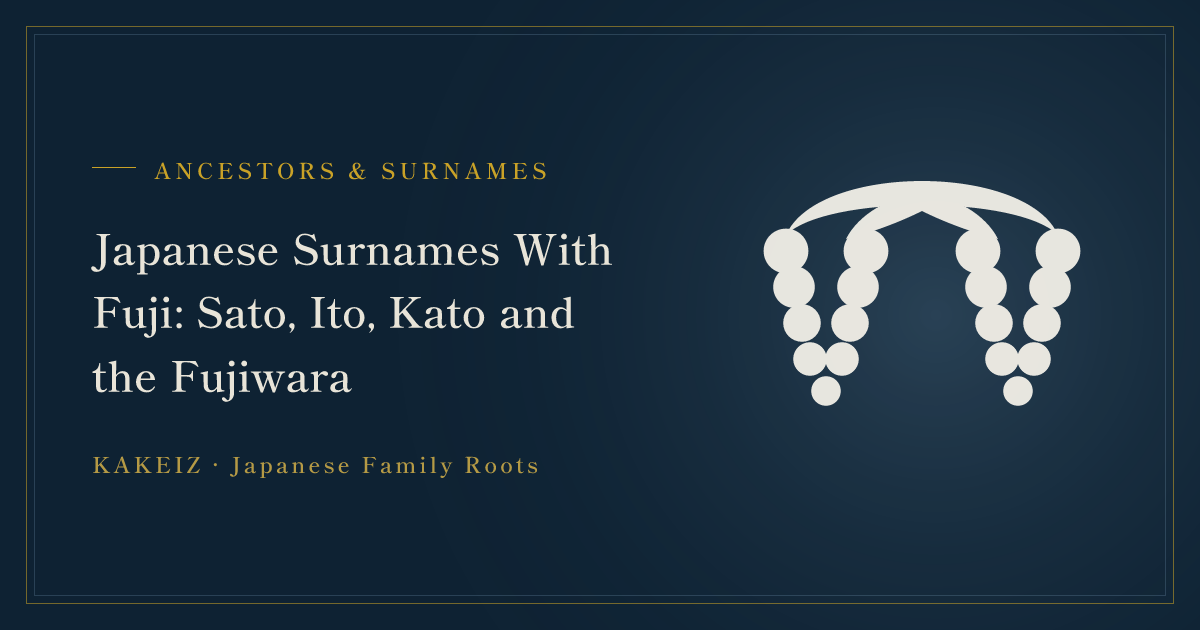
Japanese Surnames With Fuji: Sato, Ito, Kato and the Fujiwara
Many Japanese surnames with fuji (藤), like Sato, Ito, Kato and Saito, are linked to the Fujiwara clan. Learn the theories and whether 藤 means Fujiwara roots.
Sato, Ito, Kato, Saito. Japan has a great many surnames that contain the character 藤. On its own, this character is read "fuji" and means wisteria. In many surnames, it is read "to."
Most of these names are explained by one theory: families descended from the Fujiwara (藤原) clan combined the 藤 of Fujiwara with a character from their place or job title. But this is just one theory about how names formed. Having 藤 in your name does not mean your family descends from the Fujiwara.
Who were the Fujiwara?
The Fujiwara clan began with Nakatomi no Kamatari (中臣鎌足), a statesman of the 600s. Tradition says that shortly before he died in 669, Emperor Tenji granted him the clan name Fujiwara.
His descendants held enormous power at the imperial court during the Heian period (794–1185). Fujiwara no Michinaga, one of the most powerful of them, is a name every Japanese student learns in school.
Over the centuries, the clan spread throughout Japan. Many members are thought to have gone out to the provinces as government officials, and some put down roots there.
Theories behind surnames with 藤
Here are the theories told for some common names with 藤:
- Sato (佐藤): a Fujiwara of Sano, or a Fujiwara who held the court post saemon-no-jo (左衛門尉)
- Ito (伊藤): a Fujiwara connected to Ise Province, around today's Mie Prefecture
- Kato (加藤): a Fujiwara who held an office in Kaga Province, around today's Ishikawa Prefecture
- Saito (斎藤): a Fujiwara who headed the office of the saigu (斎宮), the imperial princess who served at the Ise Grand Shrine
- Kudo (工藤): a Fujiwara who worked in the court's carpentry office, called moku (木工)
- Kondo (近藤) and Endo (遠藤): a Fujiwara of Omi or Totomi, two old provinces
- Goto (後藤): a Fujiwara of a province whose name included 後, such as Bingo or Higo
You can see a pattern. Many of these names put one character from a place or a job title in front of 藤.
There are many more names of this kind, such as Ando, Muto, Sudo, Naito and Shuto. For example, Muto is said to come from "a Fujiwara of the musha-dokoro," the court's guard office. Naito is said to come from "a Fujiwara who was an udoneri," a court attendant. For Ando, one theory says it joins the Abe clan and the Fujiwara. It is normal for one name to have several theories.
To people of that time, the name of a province or an office was an important sign of who a family was. By pairing it with 藤, families could set themselves apart from other Fujiwara families. At least, that is how it is usually explained.
Still, no theory applies to every family. Families with the same name often began separately in different places. For a closer look at one of these names, see our guide to the Sato surname meaning.
Does 藤 mean Fujiwara descent?
You cannot say a family descends from the Fujiwara just because its name has 藤. There are several reasons:
- The origin of many names cannot be settled by one theory
- Before and during the Edo period (1603–1868), quite a few families shaped their family trees to claim a link to a famous line
- In the Meiji era (1868–1912), when everyone had to register a surname, some families chose a familiar name or a character they liked
On the other hand, many families whose names do not contain 藤 also claim Fujiwara descent.
A surname is a door into your family's history. From there, comparing it with the koseki (戸籍), Japan's family registry, a government record that lists each household's members, along with gravestones and family records, slowly brings your family's story into focus.
The wisteria crest
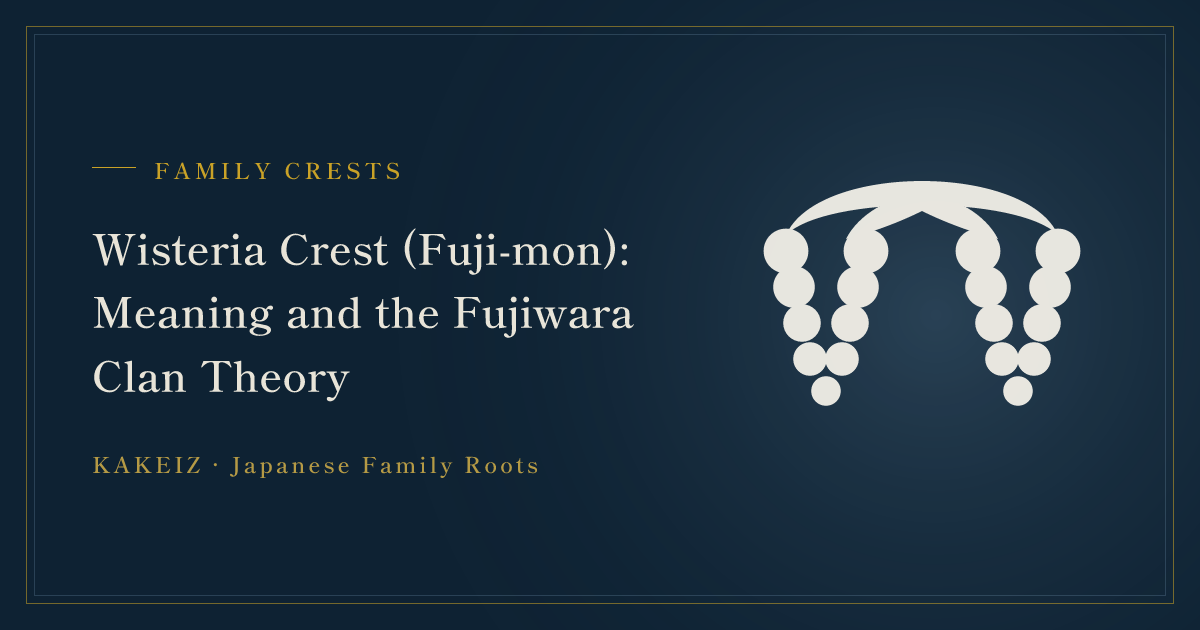
A kamon (家紋) is a family crest, a symbol each family has used for generations. A crest often linked to the Fujiwara is the fuji-mon (藤紋), shaped like wisteria flowers. But not every family with 藤 in its name uses a wisteria crest. Our guide to the wisteria crest explains more.
A note for families outside Japan
In English letters, the 藤 in a name is easy to miss. "Ito" could be 伊藤, but it could also be 伊東, a name with no 藤 at all. Checking the kanji on a gravestone, an old letter or a family document can tell you which name your family carries.
Frequently asked questions
How common are surnames with 藤?
Names like Sato, Ito and Kato often appear near the top of lists of common surnames. So names with 藤 make up a large group among Japanese surnames.
Why is 藤 read "to" in some names and "fuji" in others?
One theory is that "to," as in Sato, is the Chinese-style reading of the 藤 in Fujiwara. Names that read it as "fuji," such as Fujita (藤田), are said to often come from the wisteria plant or a place name.
How can I find out if my family descends from the Fujiwara?
You cannot tell from the name alone. Tracing back the koseki and its honsekichi (本籍地), the registered home address, and comparing it with gravestones, family trees and old records is the reliable way. Old family trees were sometimes reshaped later, so treat them as one clue.
A small step for today
If your name, or the name of someone close to you, contains 藤, think about the character in front of it. What place or job might it stand for? To see which crests often appear with your surname, you can look up crests by surname (in Japanese).
Written by Tsucchi, KAKEIZ
The KAKEIZ family-tree reading is currently in Japanese. Your browser's translate feature works well with it, and it takes about three minutes. Free, no sign-up.