KAKEIZ
Paulownia Crest (Kiri-mon): Meaning, History and Japan's Seal
The paulownia crest, or kiri-mon, began as an imperial emblem and is now the seal of Japan's government. Learn its meaning, history and the 5-3 and 5-7 types.
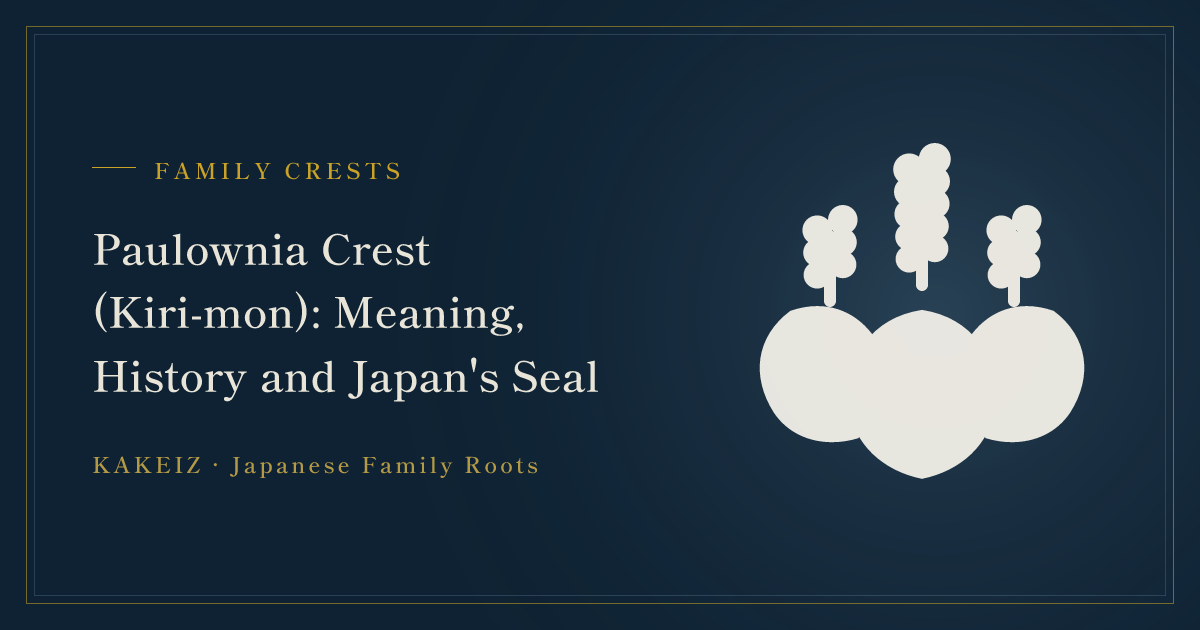
The kiri-mon (桐紋), or paulownia crest, shows the leaves and flowers of the paulownia tree. It is one of the best-known kamon (家紋), the family crests that Japanese households have passed down for generations.
The paulownia crest began as an emblem of the imperial family. Over the centuries it was granted to powerful leaders as a sign of honor. Today one version of it serves as the emblem of the Japanese government. If you have ever seen the Prime Minister speak at a press conference, you have probably seen it on the podium.
Where the paulownia crest comes from
In ancient China, the paulownia was thought of as a special tree. A legend said that when a wise and virtuous ruler appeared, the fenghuang, a mythical bird often called the Chinese phoenix (in Japanese, hōō, 鳳凰), would come to rest in a paulownia tree.
This idea traveled to Japan. The paulownia became a pattern used on the emperor's robes, and in time it became one of the crests of the imperial family. The chrysanthemum is the most famous imperial crest, but the paulownia has long been used as the next in rank.
One small note: it is said that the "paulownia" of the Chinese legend was actually a different tree, the Chinese parasol tree. The Japanese crest is based on the kiri, the true paulownia.
Go-san no kiri and go-shichi no kiri
The basic design has three leaves at the bottom, with three upright stalks of flowers rising above them. The name of the crest changes with the number of blossoms on each stalk.
- Go-san no kiri (五三桐), the 5-3 paulownia — the stalks carry 3, 5 and 3 blossoms. This is the version you will see most often.
- Go-shichi no kiri (五七桐), the 5-7 paulownia — the stalks carry 5, 7 and 5 blossoms. This version was considered higher in rank.
It is said that in earlier times, a person who received the 5-7 paulownia from the emperor might grant the 5-3 version to his own retainers. That is one reason the 5-3 type came to be seen as one step below.
To tell them apart, count the blossoms on the center stalk. Seven means 5-7. Five means 5-3. Counting the side stalks too makes it hard to get wrong.
There are many other variations as well, such as the paulownia inside a circle (maru ni go-san no kiri) and designs with reshaped leaves or flowers. You can even find a paulownia in your pocket: the Japanese 500-yen coin has paulownia leaves and flowers on one side.
A crest of rulers, and of the government
Because it was granted by the emperor, the paulownia came to be seen as the crest of those who govern the country. Giving a crest was also a way to honor someone and keep them as an ally.
Ashikaga Takauji
Ashikaga Takauji, who founded the Muromachi shogunate in 1338, is believed to have received the paulownia crest from Emperor Go-Daigo.
Toyotomi Hideyoshi
Toyotomi Hideyoshi, the warlord who unified Japan in the late 1500s, is famous for his paulownia crest. It is said to have passed from the imperial family to the Ashikaga, then to Oda Nobunaga, and finally to Hideyoshi. Hideyoshi granted it to retainers who served him well, but he also cracked down on people using it without permission. His distinctive version is called taikō-giri (太閤桐), the "Taikō paulownia," after his title. You can read more about warlords and their crests in samurai family crests of the Sengoku period.
The modern government emblem
In the Meiji era (1868–1912), the paulownia began to be used as an emblem of the government.
- The 5-7 paulownia is used by custom as the emblem of the Cabinet and the Japanese government.
- The 5-3 paulownia is used by some ministries, such as the Ministry of Justice.
In this way, the chrysanthemum stands for the emperor, and the paulownia stands for the government. Japanese passports, for example, carry the chrysanthemum on the cover.
As a family crest, though, the paulownia is extremely common. It started as a crest of high rank, but from the Edo period (1603–1868) onward it spread to a great many households. Today it is one of the crests you see most often. So a paulownia crest does not mean that a family is connected to the imperial family or to Hideyoshi.
Looking for a paulownia crest in your own family
If your family came from Japan, a crest may be hiding in plain sight. Look closely at a grandparent's gravestone, an old black formal kimono with small white crests (mon-tsuki), a butsudan (the household Buddhist altar), or lacquerware brought over from Japan. Old studio photos can help too, since crests on formal kimono often show up on the chest and sleeves.
If you find a paulownia, count the blossoms and note whether there is a circle around it. Take a clear photo. Then, if you can, ask relatives in Japan whether they know the crest's name. Families with the same surname do not always share the same crest, so your own family's records are the best guide.
Frequently asked questions
If our crest is a paulownia, are we a family of high status?
Not necessarily. The paulownia spread widely over time and became one of the most common crests. Every family's crest is meaningful, but a crest alone cannot tell you a family's history.
Which should our family use, the 5-3 or the 5-7?
Today there is no rule that forbids either one. The basic idea is to use the form your family has passed down. If you are not sure, check the crest on a family grave or on old kimono.
I found a paulownia crest on a grave outside Japan. What does it tell me?
It tells you which crest that family used, which is a valuable clue. It does not prove a link to any famous clan. Write down the exact design, including the blossom count and any circle, and compare it with what relatives remember.
A small step for today
If you have a 500-yen coin, take a close look at it, or find a photo of one online. The paulownia on it carries more than a thousand years of history. Then, if you want to see which crests are often linked to your family name, try the crest lookup by surname (in Japanese).
Written by Tsucchi, KAKEIZ
The KAKEIZ family-tree reading is currently in Japanese. Your browser's translate feature works well with it, and it takes about three minutes. Free, no sign-up.