KAKEIZ
Mon-tsuki Kimono: One, Three and Five Crests Explained
What do one, three and five crests on a mon-tsuki kimono mean? Learn where each crest goes, how the number sets formality, and what crests reveal about family.
Look at photos of a Japanese wedding and you may see the groom's father in a black kimono with a pleated skirt. The mothers of the bride and groom may wear black kimono with a colorful pattern near the hem. On all of these, small white crests appear in a few places.
These crests are kamon (家紋), family crests. A kimono that carries them is called a mon-tsuki (紋付), meaning "with crests." And the number of crests matters.
There are three main styles: itsutsu-mon (五つ紋), five crests; mitsu-mon (三つ紋), three crests; and hitotsu-mon (一つ紋), one crest. The number changes the kimono's level of formality, or how serious the occasion is that it is meant for.
Where the crests go
First, learn the positions. Each has its own name:
- Se-mon (背紋) … The center of the back, just below the neck
- Sode-mon (袖紋) … The back of each sleeve
- Daki-mon (抱き紋) … The left and right sides of the chest
The number of crests comes from combining these:
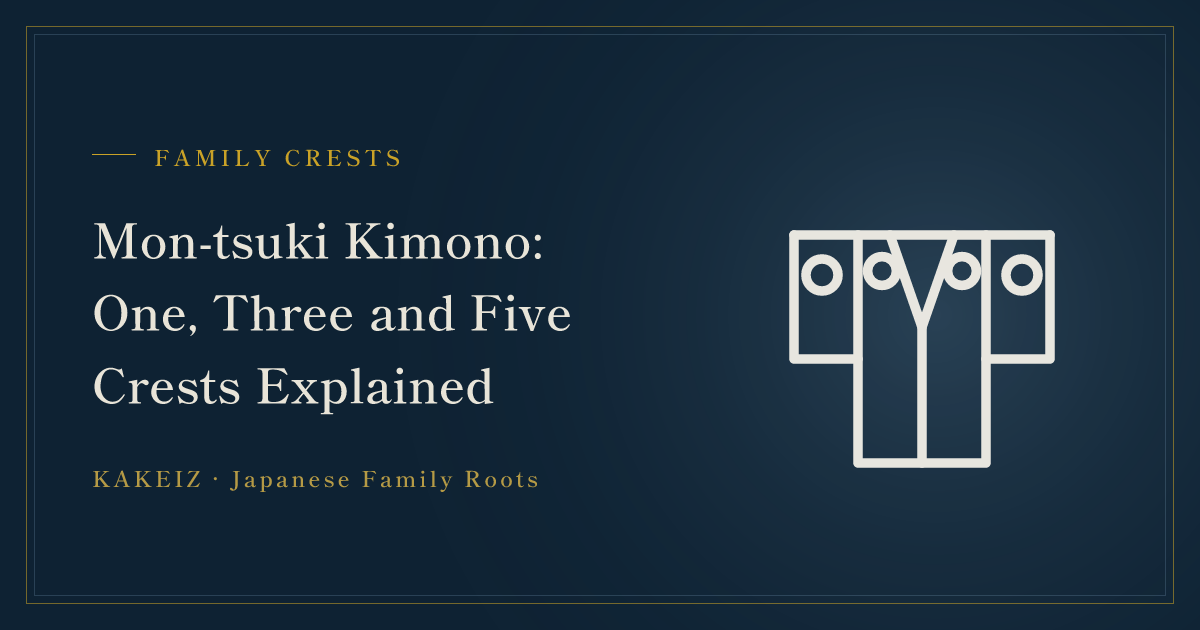
- Five crests … Back, two sleeves and two chest crests
- Three crests … Back and two sleeves
- One crest … Back only
A simple way to remember: three crests is five crests without the chest crests. One crest is just the back crest left alone.
The number of crests and formality
The basic idea is simple: the more crests, the more formal the kimono.
Five crests: the most formal
Five crests mark the most formal dress of all. They are worn at the most important ceremonies. Examples include:
- Kuro mon-tsuki haori hakama (黒紋付羽織袴) … Men's most formal dress: a black crested kimono with a haori (羽織), a jacket worn on top, and hakama (袴), wide pleated trousers.
- Kuro-tomesode (黒留袖) … A black kimono with a pattern only below the waist, worn by mothers and close female relatives at weddings.
- Mofuku (喪服) … Mourning clothes worn at funerals.
At both weddings and funerals, the most formal kimono carries five crests. There is a sense of standing at the event as a representative of the family, with the family crest on your back.
Three crests: semi-formal
Three crests are a step less formal. They are often placed on an iro-tomesode (色留袖), a colored version of the formal kimono, or on an iro-muji (色無地), a single-color kimono. These are worn to a relative's wedding or other celebrations.
One crest: lightly formal
One crest is the least formal of the crested styles. On a single-color kimono or a houmongi (訪問着), a "visiting kimono" with flowing patterns, one crest makes it suitable for a tea ceremony, a school entrance ceremony, or a small celebration. It gives a slightly more formal look than a kimono with no crest.
How the crest is made also matters
Formality depends not only on the number of crests, but also on how they are made:
- Somenuki-mon (染め抜き紋) … The crest shape is left white by dyeing around it. This is the most formal.
- Nui-mon (縫い紋) … The crest is embroidered. This gives a softer, less formal look.
The most formal of all is a kimono with five dyed crests.
Which kimono suits which occasion can also depend on the region, family customs and the times. When in doubt, Japanese families often ask a kimono shop or an older relative.
Crested kimono as clues to your family crest
A crested kimono is also one of the best clues to a family's crest.
If a grandparent's or parent's mourning kimono or black formal kimono has been kept, look closely at the back crest. That is the crest the family has used.
There is one thing to keep in mind. In some regions, a woman's kimono carries a crest she inherited from her birth family, called onna-mon (女紋). So a mother's kimono and a father's kimono may show different crests. This is not unusual. Our article on onna-mon, the women's family crest explains this custom.
For families outside Japan, a kimono may be one of the few heirlooms that came from Japan. Even if no kimono survived, old wedding and funeral photos often show crests clearly on the shoulders and chest. Counting them can also tell you how formal the occasion was.
When you find a crest, take a photo. Is it inside a ring? Are the lines thick or thin? These small details help identify its name. See our guide to crest variations like maru and kage for how to read them.
Frequently asked questions
How many crests go on a mourning kimono?
Mourning kimono are the most formal dress, so five dyed crests are standard. In some regions, a woman's mourning kimono carries her birth family's crest or an onna-mon. If you are unsure which crest to use, ask an older family member.
Can a crest be added to a kimono later?
Yes, if the kimono has kokumochi (石持), plain white circles left where crests will go. Crests are usually added by a kimono shop or a crest artisan. There are also stick-on crests, so it is worth asking what fits your purpose.
Can I wear a crested kimono if I live outside Japan?
Yes. Crested kimono are worn at weddings, funerals and cultural events by people of Japanese descent in many countries. If you are having a crest added, it is best to confirm your family's crest with relatives first.
A small step for today
If your family has a crested kimono or a mourning kimono, look at the crest on the back without even unfolding it. If not, an old wedding photo works too. Count the crests and talk about it with your family. To look for your crest's name, you can look up crests by surname on our crest page, which is in Japanese.
Written by Tsucchi, KAKEIZ
The KAKEIZ family-tree reading is currently in Japanese. Your browser's translate feature works well with it, and it takes about three minutes. Free, no sign-up.