KAKEIZ
Aoi Crest Meaning: The Tokugawa Hollyhock and Its Shrine Roots
The aoi crest meaning explained: how the Tokugawa three-leaf hollyhock links to the two-leaf crest of Kyoto's Kamo shrines, and why its use was once limited.
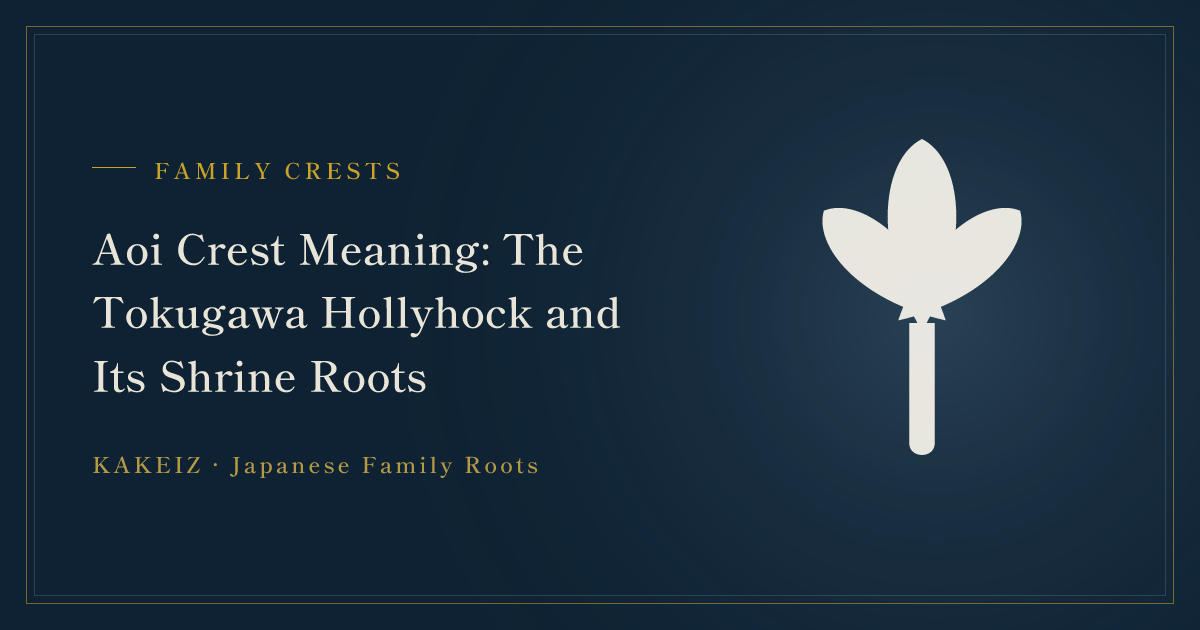
In Japanese historical dramas, there is a famous scene. A character holds up a small lacquered case and asks, "Do you not see this crest?" Everyone bows at once. The crest on that case is the mitsuba aoi (三つ葉葵), the three-leaf aoi of the Tokugawa family, who ruled Japan as shoguns for over 250 years.
A Japanese family crest is called kamon (家紋). The aoi crest is one of the most recognizable. In English it is often called the hollyhock crest. It is said to come from the aoi leaves held sacred at the Kamo shrines in Kyoto. A plant tied to the gods later became the crest of a warrior family.
The plant behind the aoi crest
The aoi in this crest is not the tall hollyhock with big summer flowers. The plant behind it is said to be futaba aoi (フタバアオイ), a small woodland plant.
- It grows low to the ground in the shade of mountain trees.
- Each stem bears two heart-shaped leaves.
- Its small flowers bloom hidden beneath the leaves.
A design based on these two leaves is called futaba aoi (二葉葵), "two-leaf aoi."
It is said the plant got the name aoi because its leaves look like those of the mallow family. Botanically, though, futaba aoi is a kind of wild ginger, not a mallow at all. The name and the plant's true family do not match, which is part of its charm.
Types of aoi crests
There are several aoi designs:
- Futaba aoi … Two leaves. Closely tied to the Kamo shrines.
- Mitsuba aoi … Three leaves arranged in a circle. Famous as the Tokugawa crest.
- Tachi aoi (立ち葵) … The stem and leaves standing upright.
Like other crests, aoi designs are told apart by the number and direction of leaves, and whether they are inside a ring.
The Kamo shrines and the Aoi Festival
Futaba aoi has long been treated as a sacred plant at the Kamo shrines, the two great Shinto shrines of Kamigamo and Shimogamo in Kyoto. The two-leaf aoi is known as their shinmon (神紋), a shrine's crest.
Every year on May 15, Kyoto holds the Aoi Matsuri (葵祭), the Aoi Festival. People in the procession, and even the ox carts, are decorated with futaba aoi leaves. The festival takes its name from the plant.
A theory about the name "aoi"
In old Japanese, aoi was written "afuhi." One theory links this to "au hi" (逢う日), meaning "the day of meeting," as in the day of meeting the gods. It may sound like wordplay, but it fits a plant so closely tied to sacred rites.
How the Tokugawa came to use the three-leaf aoi
Tokugawa Ieyasu (1543–1616), founder of the Tokugawa shogunate, came from the Matsudaira family of Mikawa Province, today's eastern Aichi Prefecture. There are several theories about why the Matsudaira used the aoi crest:
- One says the Matsudaira of Mikawa had ties to the Kamo shrines.
- Another says they took the crest from a retainer family in the same province.
No one knows for certain which is true. But most theories agree that the aoi crest was tied to sacred rites from the start.
Limited use in the Edo period
After the Tokugawa took power, the three-leaf aoi became a special crest. During the Edo period (1603–1868), it is said that families outside the Tokugawa and their relatives were strictly kept from using the aoi crest.
Meanwhile, some retainer families, such as the Honda family, used tachi aoi, the upright version. The same plant was handed down in a different shape. A crest's form can hint at the path a family has walked. To learn about other warlord crests, see our guide to samurai family crests of the Sengoku warlords.
For families outside Japan, an aoi crest on a grandparent's gravestone or an old kimono is worth a careful look. Count the leaves and note whether they stand or lie flat. Those details tell you which aoi you are looking at. If the crest has a ring around it, note that too, since a ring makes it a separate crest. A clear photo taken straight on is the best record. You can share it with relatives in Japan, who may remember the crest from family memorial services or from the family grave.
Frequently asked questions
Are all families with an aoi crest descended from the Tokugawa?
Not necessarily. There are several kinds of aoi crest, including futaba aoi and tachi aoi. Some families used them because of ties to a shrine, or through service as retainers. A crest alone cannot prove descent.
How many leaves should an aoi crest have?
It depends on the crest. The Kamo shrines' futaba aoi has two leaves, and the Tokugawa crest has three leaves in a circle. The number and arrangement of leaves make them different crests.
Can a family use the aoi crest today?
There are no strict rules like those of the Edo period today. Many families have long used an aoi crest as their own. However, using a crest on products can involve trademarks or other rights, so check before doing so.
A small step for today
Look at your family grave or crested kimono for a crest of aoi leaves. Count the leaves and check whether they stand up or lie flat. If you do not know your family's crest yet, you can look up crests by surname on our crest page. The page is in Japanese, but the crest images are easy to compare.
Written by Tsucchi, KAKEIZ
The KAKEIZ family-tree reading is currently in Japanese. Your browser's translate feature works well with it, and it takes about three minutes. Free, no sign-up.