KAKEIZ
Sato Surname Meaning: Origins, Regions and Family Crests
The Sato surname meaning is often linked to the Fujiwara clan. Learn the main theories, why Sato is common in northeast Japan, and the family crests often seen.
Sato (佐藤) is among the most common surnames in Japan. A widely told theory says it began with families descended from the Fujiwara (藤原) clan, who combined the "to" of Fujiwara with a character from a job title or a place.
Sato is especially common in the Tohoku region, the northeast of Japan's main island. But even among families named Sato, the roots can be very different. Here is what is known, and what is only said.
The Sato surname meaning
The second character in Sato, 藤, is read "to" here. It also means wisteria. It is said to be the same character as the "Fuji" in Fujiwara.
The Fujiwara were a noble clan that held great power at the imperial court during the Heian period (794–1185). Over time, their descendants spread across Japan.
So where does the first character, 佐 (sa), come from? There are several theories:
- The court title theory: a descendant of Fujiwara no Hidesato (藤原秀郷), a warrior of the 900s, held a court post called saemon-no-jo (左衛門尉), and the family became "Sato"
- The Sano theory: a Fujiwara family that lived in Sano, in old Shimotsuke Province (today's Tochigi Prefecture), took the name
- The Sado theory: the name came from a Fujiwara family connected with Sado, an island that is now part of Niigata Prefecture
None of these is settled. It is also said that some families added a link to the Fujiwara to their family trees later on.
In addition, when ordinary people registered surnames in the late 1800s, some families are thought to have chosen Sato simply because it was a familiar name. You can read more about that period in our guide to Japanese surname history.
Where Sato families live
Sato families live all over Japan, but the name is especially common in Tohoku and Hokkaido.
It is said to be the most common surname in many Tohoku prefectures, such as Akita, Yamagata, Miyagi, Iwate and Fukushima. It is also said to be common in Niigata and in Oita, on the southern island of Kyushu.
Reasons often given include the spread of families descended from Fujiwara no Hidesato into the northeast, and ties with the Oshu Fujiwara, a branch that ruled the far north in the 1100s. But these are theories too.
To find out which Sato your family is, the name alone is not enough. In Japan, families are recorded in the koseki (戸籍), the family registry, a government record that lists each household's members. Each koseki has a honsekichi (本籍地), the family's registered home address. Tracing it back can show where your ancestors lived. Once you know the region, you can read your family's story alongside that region's history.
Keep in mind that the number of Sato families and the name's national ranking vary by survey, because surveys use different data.
A note for families outside Japan
Many Sato families settled abroad. If you only know the name in English letters, it may also appear as Satoh or Satou. Note that a different surname, 里, is also written "Sato" in English. Checking the kanji on a gravestone, an old letter or a family document can confirm which name your family carries.
Family crests and well-known Sato families
A kamon (家紋) is a family crest, a symbol each family has used for generations on things like gravestones, kimono and household items.
Crests often seen with Sato
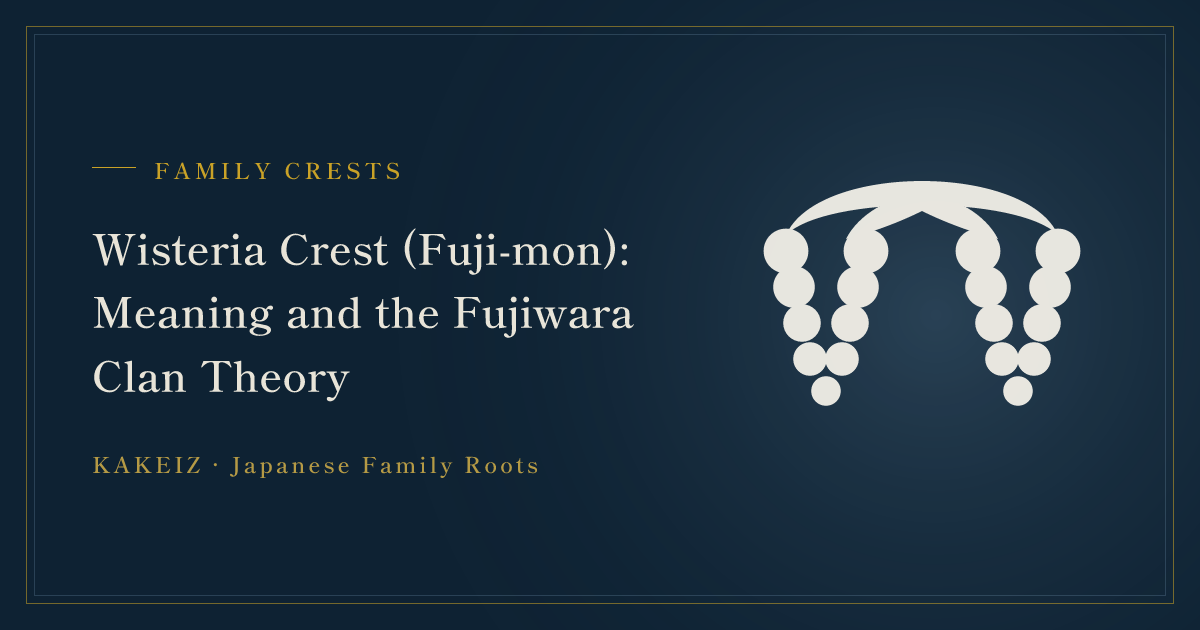
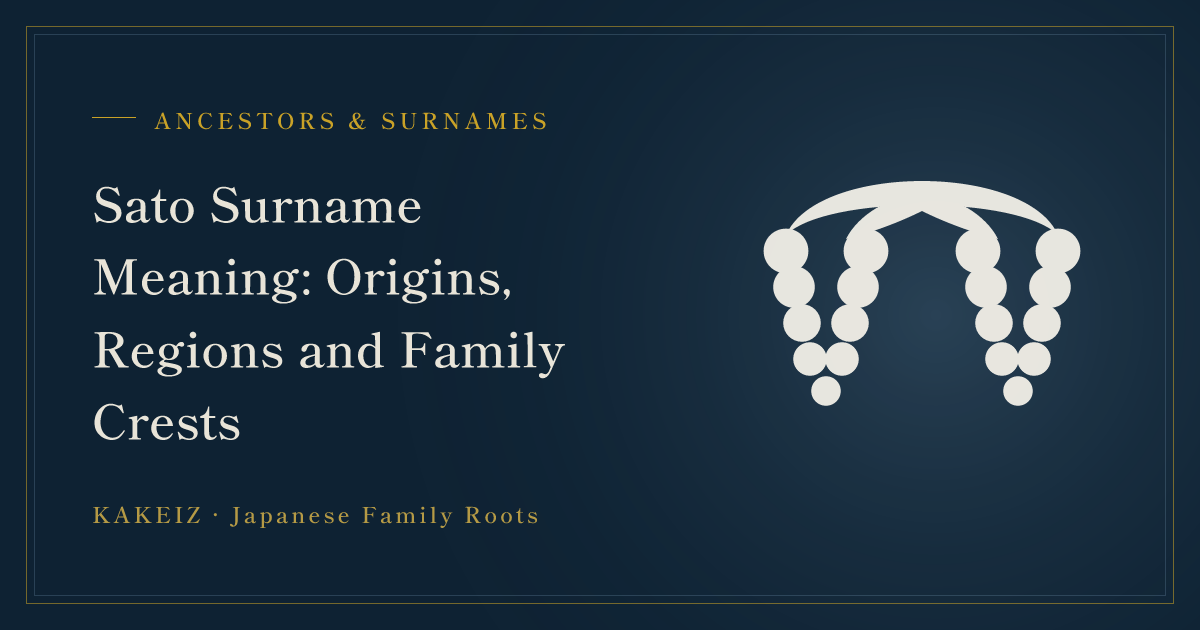
Because of the link with the Fujiwara, many Sato families are said to use a fuji-mon (藤紋), a wisteria crest. A common version is sagari-fuji (下がり藤), with hanging wisteria flowers.
Another crest often linked with Sato is genji-guruma (源氏車). It shows the large wheel of an ox-drawn carriage, the kind Heian nobles rode in. Thin spokes spread out from the center inside a ring. Why it is common among Sato families is not clear.
Remember that each family chose its own crest. Many Sato families use completely different crests.
Well-known people named Sato
- Sato Tsuginobu (継信) and Sato Tadanobu (忠信): brothers who served the famous warrior Minamoto no Yoshitsune in the late 1100s. They appear in The Tale of the Heike and other classic stories
- Saigyo (西行): a celebrated poet of the 1100s. Before he became a Buddhist monk, his name was Sato Norikiyo (義清)
Sharing a name with a famous person does not mean your family descends from them. It is important to keep those two things apart.
Frequently asked questions
Are all Sato families descended from the Fujiwara?
No, not necessarily. There is a theory linking Sato to the Fujiwara, but some families are thought to have chosen the name in the 1870s, when everyone had to register a surname.
Is there one official Sato family crest?
No. Sagari-fuji and genji-guruma are often seen, but crests differ from family to family. The quickest way to find yours is to check a family gravestone or a formal kimono, which often shows the crest.
Why are there so many Sato families in northeast Japan?
Reasons often given include the spread of families descended from Fujiwara no Hidesato and ties with the Oshu Fujiwara. But this is only one theory. Some families are thought to have picked the familiar name Sato in the Meiji era (1868–1912).
A small step for today
Look for your family crest on a gravestone, a ceremonial kimono or an old household item. Is it a wisteria, a wheel or something else entirely? Each clue helps you find "our Sato" among many. To see which crests often appear with a surname, you can look up crests by surname (in Japanese).
Written by Tsucchi, KAKEIZ
The KAKEIZ family-tree reading is currently in Japanese. Your browser's translate feature works well with it, and it takes about three minutes. Free, no sign-up.