TSUGIMON
Fujiwara Surname Meaning: From Nakatomi no Kamatari to Today
Fujiwara surname meaning and origins: how Nakatomi no Kamatari received the name in 669, the Heian-era clan, clan names versus surnames, and wisteria crests.
The name Fujiwara (藤原) is said to begin with Nakatomi no Kamatari (中臣鎌足), a statesman of the 7th century who received the name Fujiwara from Emperor Tenji.
His descendants went on to dominate the imperial court during the Heian period (794–1185). But that does not mean every Fujiwara alive today descends from that family. To understand why, it helps to know the difference between a clan name and a surname in Japanese history.
Where the Fujiwara name comes from
Nakatomi no Kamatari
Kamatari is known for working with Prince Naka no Oe, later Emperor Tenji, to push through the Taika Reforms, a set of changes that strengthened the central government in the 640s.
According to tradition, in 669, shortly before his death, Kamatari was granted the name Fujiwara by Emperor Tenji. One theory is that it came from the name of a place connected to Kamatari. The characters mean "wisteria" (藤, fuji) and "field" or "plain" (原, hara or wara).
Fujiwara no Fuhito and the four houses
Kamatari's son, Fujiwara no Fuhito (藤原不比等), passed the name on. Fuhito's four sons each founded a house: the Southern, Northern, Ceremonial, and Capital houses.
The Northern House became the most powerful. For generations its leaders served as regents, ruling on behalf of emperors. Fujiwara no Michinaga, who lived around the year 1000, is the most famous of them.
The Fujiwara kept their power in large part through marriage. Daughters of the clan became empresses, and their sons became emperors, so the clan's leaders were often the grandfathers or uncles of the reigning emperor. This was the world of the Heian court, the same world described in classic works of literature from that era. Writers such as Murasaki Shikibu, author of The Tale of Genji, served at a court where Fujiwara influence was everywhere.
Over the centuries, the clan's branches spread widely. Court nobles, provincial officials, and warrior families all claimed Fujiwara ancestry, some with good evidence and some without. By the medieval period, saying "our family descends from the Fujiwara" was a common way to claim an honorable past.
Clan names versus surnames
Here is the key point. Fujiwara was originally an uji (氏), a clan name. An uji was the official name of a lineage, granted by the emperor.
As the clan grew, its many households needed a way to tell each other apart. They began to use separate everyday names, often taken from where they lived. These became myoji (名字), surnames. From the Fujiwara Northern House, for example, came noble court families such as Konoe (近衛) and Kujo (九条).
So most descendants of the Fujiwara clan actually went by other surnames in daily life. On formal documents, they might still use the clan name in a style like "Fujiwara no Ason," but their household was known by its surname.
Where, then, do today's Fujiwara families come from? In the early Meiji era (1868–1912), every citizen was required to register a surname. Some families whose traditions linked them to the Fujiwara clan chose the name, and others may have chosen it because it was a familiar, respected name. The reading can be either Fujiwara or Fujihara.
This is also why many other surnames contain 藤 (to or fuji), such as Sato, Kato, and Ito. A common theory says these came from families of Fujiwara descent, though each family's story is different. See Japanese surnames with Fuji for more.
Fujiwara families and wisteria crests
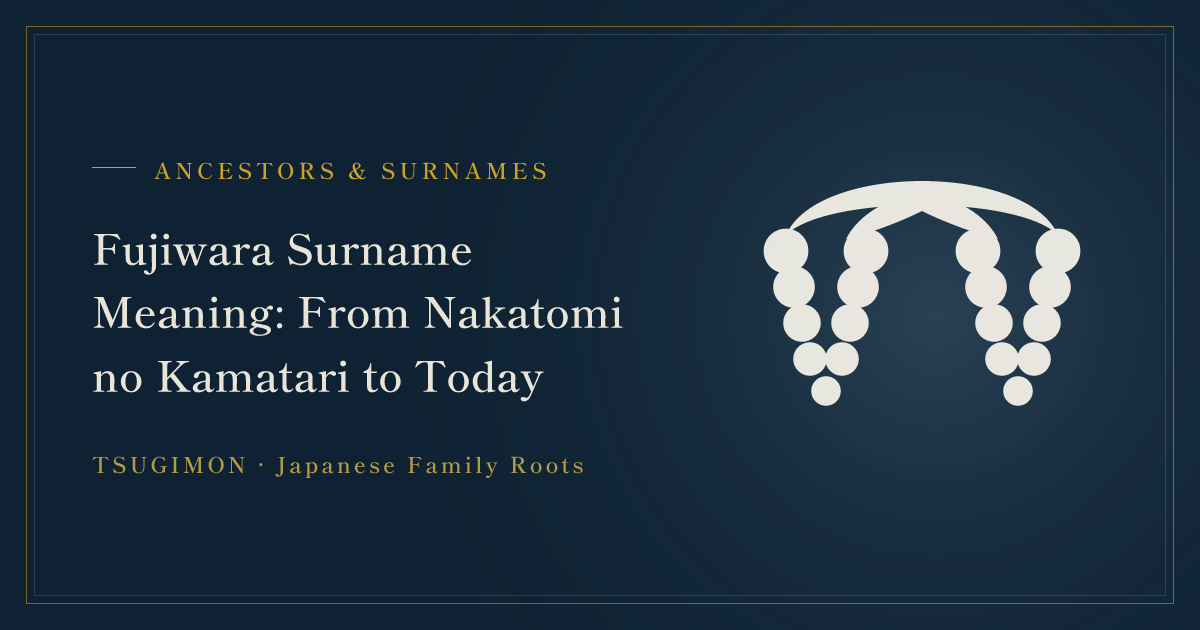
Because of the link to the Fujiwara clan, many families with this name are said to use a fuji-mon (藤紋), a wisteria crest. The best known is sagari-fuji, "hanging wisteria," with flower clusters drooping down in a circle. Learn more in our article on the wisteria crest.
Still, a kamon (家紋), the family crest, was chosen family by family. Not every Fujiwara uses wisteria. Never assume a crest from a surname.
To trace your own family, the most reliable record is the koseki (戸籍), Japan's family registry — a government record that lists each household's members. Older koseki show the honseki (本籍), the family's registered address, which can point to the region your ancestors came from.
If you live outside Japan, look first at what your family kept: a grandparent's letters, old photographs, or a gravestone that may show a crest or a village name. Relatives in Japan may remember details that never made it into any record.
Frequently asked questions
Is every Fujiwara a descendant of Kamatari?
Not necessarily. Most descendants of the Fujiwara clan went by other surnames for centuries. Some of today's Fujiwara families likely chose the name when surnames were registered in the Meiji era.
Are Sato and Kato also related to the Fujiwara?
A well-known theory says the 藤 in these names comes from families of Fujiwara descent. It is only a theory, though, and each family's origins are different.
My Fujiwara family emigrated generations ago. Where do I start?
Begin with names and places. Write down every ancestor's name you know, and look for a prefecture or village in old documents or on gravestones. With that, a relative or researcher in Japan has something concrete to work from.
A small step for today
Check a family gravestone, a household altar, or an old formal kimono for a crest, and take a clear photo. If you find one, you can compare its shape with crests listed under your surname on our crest lookup by surname (in Japanese). It is in Japanese, but the images make it easy to compare shapes.
Written by Tsucchi, TSUGIMON
The TSUGIMON family-tree reading is currently in Japanese. Your browser's translate feature works well with it, and it takes about three minutes. Free, no sign-up.