TSUGIMON
Family Tree Sibling Order: How to Arrange Brothers and Sisters
Family tree sibling order made simple: how to arrange brothers and sisters on a Japanese-style family tree, plus twins, half-siblings, and adopted children.
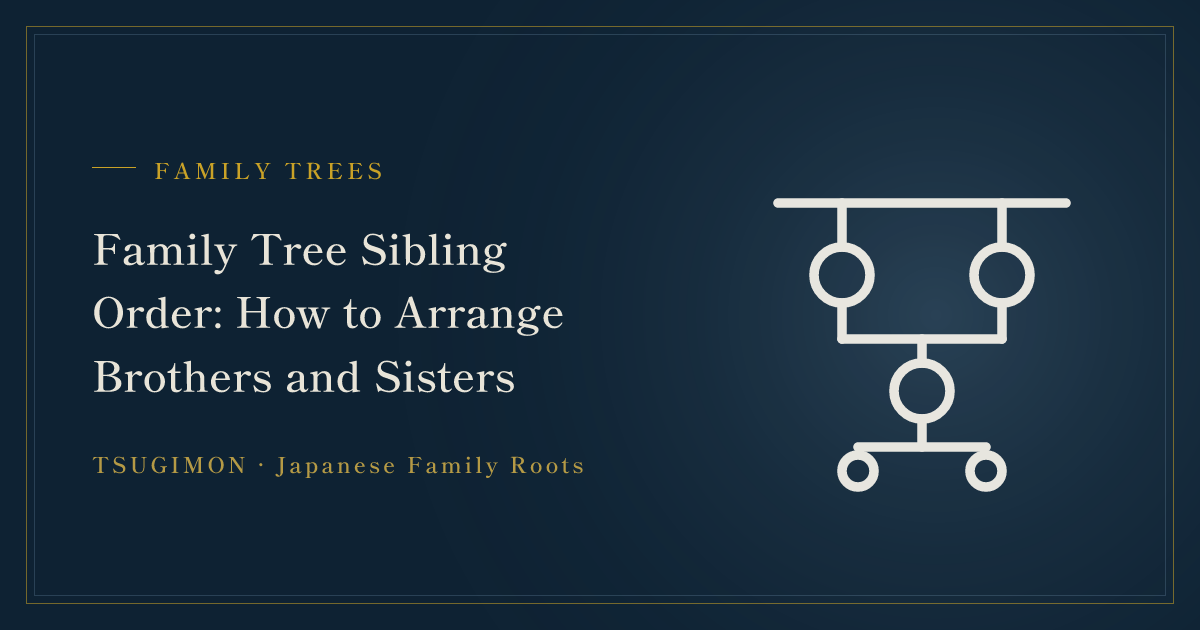
When you start drawing a family tree, one small question comes up again and again: in what order should the brothers and sisters go?
Should boys come first? Which side do you start from? The basic rule is simple, and once you know it, the rest falls into place.
The basic rule: birth order
Arrange siblings in the order they were born, regardless of whether they are boys or girls.
Some old Japanese family trees placed the eldest son, the heir, in a prominent spot, or listed all the sons before the daughters. That reflected the old idea that the eldest son carried on the house. If you are making a family tree today, birth order is the clearest choice, and anyone who reads it later will understand it right away.
Japanese family records follow birth order too. On a koseki (戸籍), Japan's family registry, children are described by their relationship to their parents, such as chonan (長男, eldest son), chojo (長女, eldest daughter), jinan (二男, second son), and jijo (二女, second daughter). Sons and daughters are each numbered by birth order. The koseki writes second sons and daughters with the character for "two" (二), rather than the everyday character meaning "next" (次), though both are read the same way.
Vertical or horizontal: which way to read
The direction depends on how your tree is laid out.
- Vertical writing (traditional Japanese style): siblings go from right to left. The eldest child is on the far right.
- Horizontal writing (like English): siblings go from left to right. The eldest child is on the far left.
An easy way to remember it: follow the same direction you would read the text.
Connecting the lines
Draw a line down from the parents, run it sideways, and drop a short line from it to each child. Married couples are often joined with a double line (=). Adding each person's birth year next to their name makes the order clear at a glance.
Large families can make a tree very wide. If the siblings will not fit, tighten the spacing, or move each sibling's spouse and children onto a separate page. Sketching it first in pencil helps you see the overall width before you make a clean copy.
Next to each name, it helps to add the year of death and any married surname. Those small notes are very useful when you come back to the tree years later. For a full walkthrough, see how to make a Japanese family tree.
Cases that are easy to get wrong
Twins
Place the twin who was born first as the elder sibling. Under Japan's current family registry practice, the first-born twin is treated as the older brother or sister.
Children who died young
Include children who died in infancy or childhood in their birth-order position. Old koseki often list such children, and many families no longer remember them. Writing them into the tree is a quiet way of recognizing that they were part of the family. In the past, many children did not survive early childhood, so do not be surprised if an old record shows several brothers or sisters you never heard about.
Half-siblings
If siblings have different mothers or fathers, for example because of a remarriage, group them under each set of parents. If a father married twice, place the children of his first marriage under him and his first wife, and the children of his second marriage under him and his second wife.
Adopted children
Connect an adopted child to the adoptive parents. If the birth parents are known, you can show that link with a dotted line so that later readers understand both connections.
Adoption appears very often in old Japanese family trees and records. Families without an heir commonly adopted a relative's child or a son-in-law to carry on the house. Noting which family an adopted person came from also shows how two families were linked.
A note for readers outside Japan
If you are combining a Japanese family tree with relatives born abroad, you can use the same rules for everyone. If you want your tree to read naturally in English, horizontal layout with the eldest on the left is usually easiest. If you have an old tree drawn in Japan, remember it may run right to left.
Frequently asked questions
Is it wrong to put the eldest son in the center?
It is not wrong. Older family trees sometimes did this to highlight the heir. For a tree you are making today, though, birth order is easier for everyone to read, so it is the better choice.
What if I do not know the birth order?
Old koseki list each person's date of birth and a relationship term such as "eldest son" or "second daughter," which can confirm the order. If you still cannot tell, place the siblings in your best guess and add a small note such as "order unknown."
How do I show a sibling who married and changed surnames?
Keep the sibling in their birth-order position under their parents, and write the married surname next to their birth name. You can then draw their spouse beside them with a double line.
A small step for today
Write down your own brothers and sisters, and then your parents' brothers and sisters, each in birth order. Just lining them up can make the shape of your family much clearer. To learn more about KAKEIZ, visit our English introduction page.
Written by Tsucchi, TSUGIMON
The TSUGIMON family-tree reading is currently in Japanese. Your browser's translate feature works well with it, and it takes about three minutes. Free, no sign-up.