TSUGIMON
Daruma Doll Meaning: Painting the Eyes and Saying Goodbye
Daruma doll meaning explained: where the round red figure comes from, which eye to paint first, what the colors mean, and how to respectfully let a daruma go.
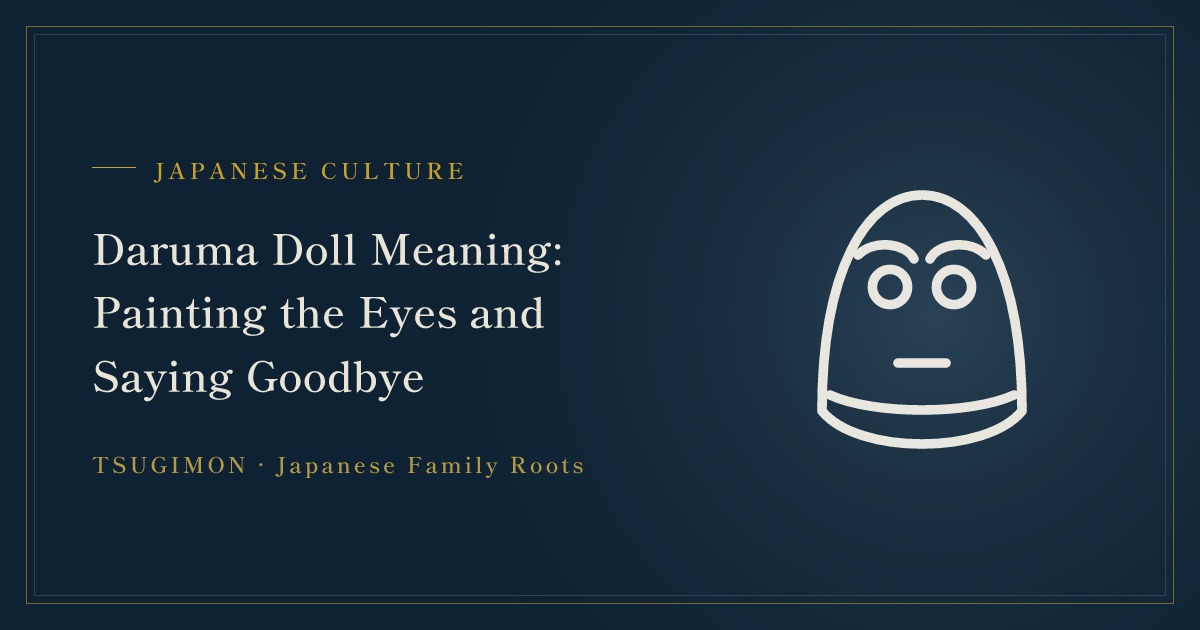
In Japan, you may see a politician on election night painting an eye onto a big red doll. That doll is a daruma (だるま), one of Japan's best-loved good-luck charms.
A daruma comes into a home together with a wish. Here is what it means, how its eyes are painted, and how to say goodbye to it when its job is done.
Where the daruma comes from
The daruma is modeled on Bodhidharma, known in Japan as Daruma Daishi (達磨大師). He was a monk who is traditionally credited with founding Zen Buddhism.
According to legend, Bodhidharma sat in meditation facing a wall for nine years, and during that time he lost the use of his arms and legs. The daruma's round, limbless shape is said to come from this legend.
The daruma's other famous feature is that it always rights itself. Its base is weighted, so if you knock it over, it rolls back upright. Because of this, the daruma carries the spirit of the Japanese saying nanakorobi yaoki (七転び八起き), "fall down seven times, get up eight," meaning to keep getting back up no matter how many times you fail.
Why are most daruma red?
Red has long been considered a color that wards off evil in Japan. It is also said that Bodhidharma wore red robes.
Today you can find daruma in white, yellow, gold, black, and many other colors. Shops sometimes give each color its own meaning, but there is no fixed tradition behind these meanings.
Which eye do you paint first?
Daruma are usually sold with blank white eyes. You make a wish and paint in one eye. When the wish comes true, you paint in the other.
The most widely known order is:
- When you make your wish, paint the daruma's own left eye, which is the eye on your right as you face it.
- When the wish comes true, paint the daruma's right eye, which is on your left as you face it.
This varies by region and by family, and some places do the opposite.
The basic method is to fill in a solid black circle with ink. Take your time and paint it carefully, with your wish in mind.
Keep it where you can see it
A daruma with one eye painted is traditionally kept where you will see it every day, such as on a shelf or near the household shrine. Seeing it reminds you of your wish.
Each time you look at the one-eyed daruma, you remember that you are still on the way. In that sense, a daruma is less a tool that grants wishes and more a companion that watches over you as you work toward your goal.
Saying goodbye to a daruma
It is customary to keep a daruma for about a year and then return it with thanks. Many families return it after a year whether or not the wish came true.
Common ways to do this include:
- taking it to a shrine or temple that accepts daruma for otakiage (お焚き上げ), a ceremonial burning of charms and religious items
- burning it at dondo-yaki (どんど焼き), a bonfire held around Koshogatsu, the "Little New Year" around January 15, together with New Year decorations
- returning the old daruma at a daruma market held each year and bringing home a new one
Whether a shrine, temple, or event accepts daruma differs from place to place, so it is wise to check beforehand.
A note for readers outside Japan
If you live abroad, you may not have a shrine or temple nearby that accepts daruma. Some people keep a daruma as a cherished keepsake, especially one connected to a family member's milestone, such as a graduation or a new business. If you inherited a daruma from a relative in Japan, ask family members what wish it held. That story may be worth more than the object itself.
You can also start a new family custom of your own. Some families buy a daruma at the start of each year, paint one eye as they share their hopes for the year, and look back together when the year ends. It is a simple way to keep a Japanese tradition alive at home, wherever you live, and to talk with children about setting goals and not giving up.
Frequently asked questions
What should I do with a daruma if my wish did not come true?
There is no need to treat it carelessly. Return it with thanks for watching over you for a year, at a shrine, temple, or dondo-yaki. Many people then get a new daruma and make their wish again.
Can I paint the eyes myself?
Of course. It is usual for the person making the wish to paint the eyes with their own hand. For a family wish, the whole family can gather and watch as the eye is painted in.
Can I give a daruma as a gift?
Yes. Daruma are popular gifts for someone starting a new job, a new business, or studying for an exam. Giving one with blank eyes lets the recipient make their own wish.
A small step for today
Is there an old daruma on a shelf in your parents' or grandparents' home? Ask them, "What did you wish for with this daruma?" You may hear about an important turning point in your family's story. For tips on these conversations, read interviewing grandparents about family history.
Written by Tsucchi, TSUGIMON
The TSUGIMON family-tree reading is currently in Japanese. Your browser's translate feature works well with it, and it takes about three minutes. Free, no sign-up.